To describe the 2025 Formula 1 season as chaotic would be to undersell the sheer absurdity of the narrative arcs that have unfolded across continents, tire compounds, pit walls, and podiums. There has been high drama, political intrigue, the occasional miracle, and the steady, almost unnerving presence of Max Verstappen driving with the intensity of someone who has stopped caring about anything other than adding to his collection of silverware. It all began in a haze of sleep deprivation for American fans who dragged themselves in front of their TV or laptop at midnight of March 16 to witness the rain-slicked opening weekend in Australia, and somehow, from that moment forward, the season began to spiral into a kind of unpredictability that felt unreal even as you watched it happened. Anyone who went to bed well past 3 a.m. that night, barely conscious and blinking away flashes of Melbourne’s sunshine, could sense the tension building. But no early warning could have prepared anyone for the madness that unfolded afterward.
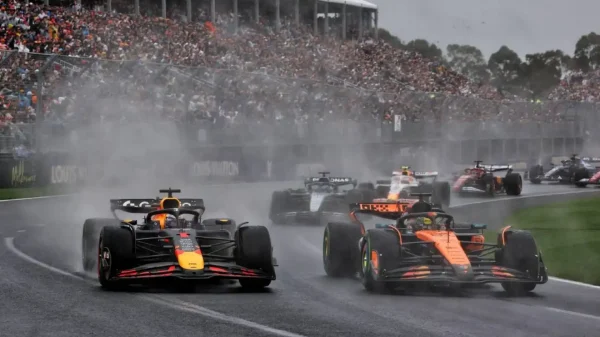
The Australian Grand Prix set the tone of unpredictable skies, unexpected pace swings, and a McLaren team that seemed to have built a car so aerodynamically dialed in that it seemed to levitate as it awarded its drivers purple sector after purple sector. McLaren’s Lando Norris snatched the victory with a combination of opportunism and weather-based fortune, though celebrated afterward as if he had single-handedly cured dampness itself. Oscar Piastri, McLaren’s other driver, looked unbelievably quick in qualifying and seemed to be on track to win his first home Grand Prix, but slid his hopes and dreams away in a particularly slippery section of the track to finish in a lowly P9. Ferrari seemed to look at their performance in 2024 and think to themselves, “What if we did just so much worse?” They proceeded to execute another trademark performance of the team’s post-2007 tomato-flavored incompetence, utterly bungling any attempt at a race strategy and crushing their star signee’s spirit right out the gate while telling their long-suffering golden boy that a water leak in his seat “must have been the water.” While this instance of hilarious miscommunication has been memed to death, it did not bode well for the team’s underwhelming form in recent years.
What really stood out after the checkered flag was not McLaren’s dominance, but Verstappen’s near-miss: he had been quicker when the track was in a tricky crossover phase between dry and wet, and had read the race almost perfectly, only losing due to the timing of his stop in worsening rain. What stood out and should have terrified the rest of the grid was that, even on a bad day, he was capable of reducing chaos to an inevitability. And inevitable is exactly what his momentum would prove to be.
Despite Piastri’s woes, McLaren and its fans left Australia with a sense of confidence and pride in their future so palpable it fogged every window in its Woking factory. The early races that followed seemed to confirm their pace advantage, with both drivers trading poles and wins like they were in the F1 video game rather than the real thing. But beneath the surface of this shiny new McLaren resurgence, hairline cracks had already formed. Their car was fast, brutally so, but only under very specific conditions: cooler track temps, clean air, and Verstappen not breathing down their necks. The moment he began to adapt and the Red Bull engineers found a performance window to exploit, the energy shifted. Meanwhile, the McLaren pit wall, continuing their team CEO, Zak Brown’s “papaya rules” racing ideology of not favoring either driver, which did nothing to control the situation. Instead, they let the two of them operate on conflicting strategies, harboring quiet resentment and leading to a polite civil war behind the radio messages.
As the European legs arrived, so did the inevitable intervention of FIA technical directives. This time it was front-wing flex under high-speed loads, and while McLaren insisted the directive would not dent their performance, the stopwatch begged to differ. Their gap shrank from untouchable to merely impressive, and Verstappen was relentless in exploiting this shift. He did not need to out-qualify them everywhere; he only needed to stay close enough that pressure itself did the heavy lifting. Pressure, after all, is a currency that McLaren has historically struggled with. When Verstappen is within ten seconds of your lead, the margin feels more like two. When he is within five seconds, it might as well be half a second. And once he appears in your mirrors, brightly colored RB21 halo catching the sunlight just so, the psychological damage is often already done.
The summer stretch saw McLaren’s early-season calm erode into something brittle. They were fast, but flustered. Norris complained about team orders that seemed to appear and evaporate depending on the wind direction. Piastri kept delivering clean, sharp weekends, only for the pit wall to hand him suboptimal calls with all the decisiveness of someone choosing dinner in a group chat. And while McLaren fought amongst themselves about who deserved priority, Red Bull gave Verstappen the one luxury no one else enjoyed: a completely unified operation that existed solely to serve his championship campaign. For all the noise about Red Bull team drama, most of it centered on personnel movement with driver swaps, quiet power struggles, reshuffling behind closed doors. But none of it compromised Verstappen. If anything, it sharpened him.
Then came Vegas. The neon, the spectacle, the blaring chaos of an over-the-top street race designed for television rather than sporting purity, all of it combined into a weekend that seemed scripted by someone with a flair for operatic absurdity. Mere hours after a divinely controlled Verstappen win, both McLarens were disqualified mere hours later for excessive skid-block wear, leading to an illegal ride height non-compliance. A 24-point swing had just come Verstappen’s way, and he wasn’t about to waste it.
In the aftermath, McLaren’s confidence turned brittle. What had looked like a tidy, controlled march toward a drivers’ championship suddenly felt precarious. The disqualification underscored how fragile advantage can be in F1. Meanwhile, Verstappen’s composure became all the more impressive for how he weathered the storm of uncertainty and walked away from Vegas with his title hopes very much alive, much many greats of the sport have before.
Qatar followed, and with it came what may be remembered as one of the most catastrophic strategic blunders in modern McLaren history. A safety car emerged after a crash in a moment of confusion where races are won or lost. Every top team except McLaren dove into the pits. McLaren hesitated, blinked, and stayed out. Verstappen pitted, exited in clean air, and proceeded to control the remaining laps with absolute authority. Piastri fought valiantly but could not undo the structural damage of his team’s hesitation. Norris floundered, radioed anxiously for help, and couldn’t add to his lead one bit, while Verstappen was picking up points left and right.
All three top drivers were now officially equal on race wins in 2025, with seven to them all, and George Russell of Mercedes being the only one else to spoil the party in Canada and Singapore.
While the paddock was packing its things, the idea of a runaway McLaren championship had gone from bankable to reasonably questionable. Verstappen, at one point more than a hundred points behind, now loomed within striking distance, and every shift in momentum favored him. Norris clung to his championship lead like a man hanging from a ledge by the fingertips, insisting confidence while quietly radiating panic. Piastri, who started the season as the rational half of the McLaren duo, had by now become the tragic figure of the campaign, his blistering pace undone again and again by bad luck, bad calls, and a team that could not see the forest of his talent through the trees of their internal politics.
All of this unfolds under the looming shadow of the 2026 regulations, which promise new engines with massive electrical deployment, radical aero rewrites, and a sport that may look and race fundamentally differently.
And now here we are, staring at a title fight between three drivers, two unraveling narratives, and one man who began this season in a car that had no business dragging him anywhere near a championship battle. Norris has the points. Piastri has the talent. Verstappen has something different, a sense of momentum, clarity, and the relentless instinct that has already carved his name into the sport’s history for his champion’s mentality.
Even if the numbers don’t fall his way this time, the season has only reinforced what the years before already proved: Max drives at a level few ever touch. He has dragged performance out of machinery that shouldn’t have allowed it, hunted down rivals who should have been out of reach, and reshaped a once-lost season with sheer force of will.
As Abu Dhabi approaches, the air feels heavy with the sense that this wild, unpredictable year may still end the way so many unforgettable seasons have ended: not because Max must win to be remembered, but because he has already shown, again, why he belongs among the greats.