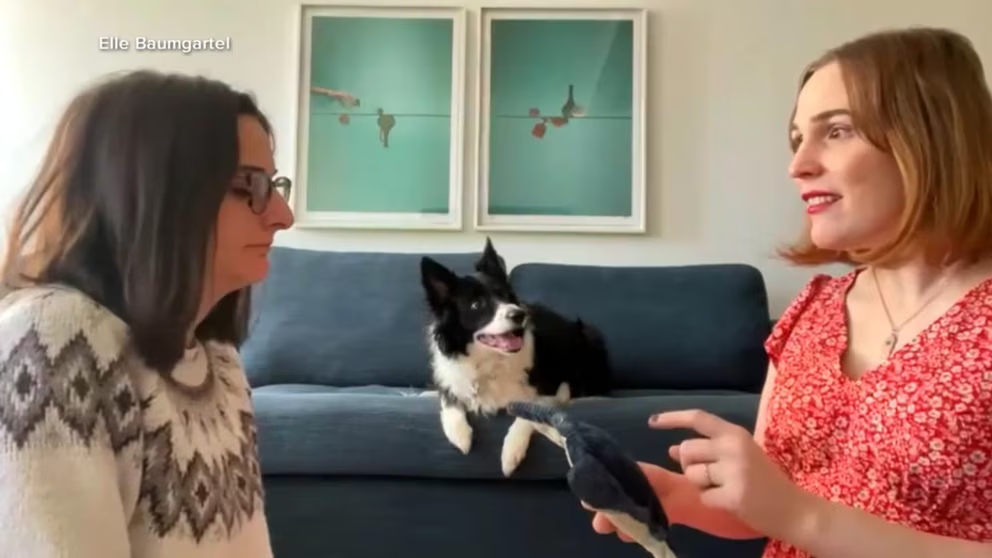

If you’ve ever whispered the word “walk” or “treat” only to have your dog come sprinting in at full speed from three rooms away, you know they’re listening. But new research suggests our canine companions aren’t just listening for their favorite words—they might actually be learning our language by “eavesdropping” on our deepest, most private conversations.
Some dogs don’t just respond to commands like sit or stay—they can learn new words, recognize different human languages, and even pick up vocabulary by listening in on conversations not meant for them. According to scientists, a small but remarkable group of dogs may be learning language in ways strikingly similar to human toddlers.
In a January 2026 study published in The New York Times, researchers examined so-called “gifted word learners,” dogs that already knew the names of dozens—or even hundreds—of objects. One border collie named Basket, for example, can identify more than 150 toys by name, from “froggy” to “Pop-Tart,” and reliably retrieve them on command.
What makes these dogs extraordinary isn’t just how many words they know, but how they learn them. Scientists found that some dogs could acquire new object names simply by overhearing their owners use the words in conversation—without direct training or eye contact. After listening to humans talk about a new toy over several days, the dogs correctly identified it nearly 80 percent of the time, a success rate comparable to when they were taught directly, according to the Times.
“That’s about the same age when human children begin learning words by eavesdropping,” Federico Rossano, a cognitive scientist at the University of California, San Diego, said. The comparison places these dogs’ abilities at roughly the level of an 18-month-old child—impressive, even if it falls short of true language use.
Other studies suggest dogs are paying attention to more than just individual words. According to the American Kennel Club, research from Eötvös Loránd University in Hungary found that dogs can distinguish between familiar and unfamiliar human languages by sound alone. In MRI scans, dogs showed different brain activity when listening to their owner’s native language versus a foreign one—even when the speech didn’t include commands they knew.
In the study, dogs raised in Spanish-speaking homes reacted differently to Hungarian speech, and vice versa. Even more surprisingly, older dogs showed stronger responses, suggesting that years of exposure to human conversation may sharpen their ability to recognize language patterns.
“Dogs are constantly bathed in human speech,” Stephanie Gibeault wrote for the American Kennel Club. “Surely they absorb the rhythms and sounds of the languages spoken in their homes.”
Still, experts urge caution before making a post about your supposed pet genius. While dogs can associate words with objects and actions, that doesn’t mean they understand language the way humans do. According to Scientific American, most dogs max out at fewer than a dozen learned words, and only a handful worldwide have demonstrated extreme abilities. Even viral TikTok “button dogs,” who appear to form sentences using soundboard buttons, may simply be responding through learned associations rather than genuine grammar.
“We desperately want them to be saying something to us,” Amritha Mallikarjun, a postdoctoral researcher at the University of Pennsylvania, told Scientific American. “But there is a lot of confirmation bias.”
What scientists agree on is that dogs are uniquely attuned to human communication. Thousands of years of domestication have shaped them to read our voices, gestures, and attention in ways few other animals can. While your dog may not be secretly bilingual, chances are they’re listening far more closely than you think.
So the next time your dog perks up when you casually mention “walk”—remember: they might just be eavesdropping.