“It [the rocket] will free man from his remaining chains, the chains of gravity which still tie him to this planet. It will open to him the gates of heaven,” declared Wernher von Braun. As a firm believer in human perseverance, I look up at the stars in awe of what mankind can achieve. We have loosened the ropes that bound us to what Konstantin Tsiolkovsky once called the cradle of humanity and propelled ourselves into a realm that has captivated our species for thousands of years. Now, humanity stands once more at the edge of the vast unknown, not merely returning to where it has been, but reaching toward what it has yet to understand. It is a mission defined not only by engineering and precision, but by awe: the same quiet, overwhelming wonder that first carried humans beyond Earth during the Apollo program. Artemis II is more than a journey through space; it shows that the universe still calls us forward.
The Artemis II mission represents a decisive step in humanity’s return to interstellar exploration, marking the first time astronauts will travel past low Earth orbit (LEO) since 1972. Led by NASA as part of its broader Artemis program, the mission tested the systems that will eventually return humans to the Moon—and, in time, carry them onward to Mars.
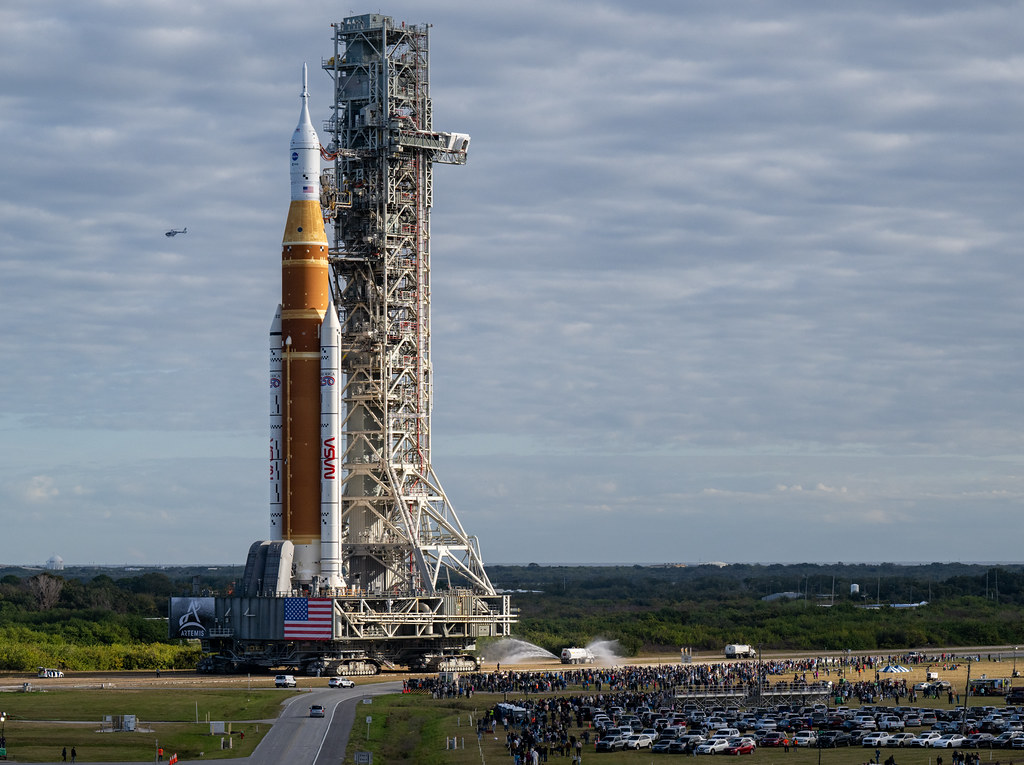
At the heart of Artemis II was the Orion spacecraft, a next-generation capsule engineered to sustain human life through the unforgiving conditions of deep space. It launched atop the Space Launch System (SLS), the most puissant rocket NASA has ever developed. Together, these technologies represent decades of innovation and international collaboration, blending cutting-edge safety systems with the hard-earned lessons of earlier missions.
Unlike its predecessor, Artemis I, Artemis II carried a crew: Reid Wiseman, Victor Glover, Christina Koch, and Jeremy Hansen. Their journey followed a lunar flyby trajectory starting on April 1, moving in a figure-eight pattern around the Earth and then around the Moon, before returning safely to Earth on April 11. This path allowed mission controllers to test life-support systems, navigation, and communication in deep space with a human crew aboard—something not done in over half a century.
The mission’s purpose was not to land, but to prove. Artemis II rigorously tested the spacecraft’s ability to support human life, evaluated its performance during the intense heat and speed of reentry, and confirmed that astronauts can operate effectively far beyond Earth’s immediate reach. These objectives now stand as essential steps toward Artemis III, the third phase of the Artemis program, with intentions of landing on the lunar surface for the first time since Apollo 17.
Beyond its technical significance, Artemis II carries profound symbolic weight. It reflects a renewed global commitment to space exploration and underscores the importance of international partnership, exemplified by Canada’s role in both crew and technology. “We are going for all humanity,” Hansen said. The mission also represents a meaningful step forward in representation, featuring the first woman and the first person of color to journey beyond LEO—milestones that broaden the narrative of who space exploration is for.
In many ways, Artemis II is a bridge between eras. It draws from the legacy of Apollo while pushing decisively into the future with new technologies and broader ambitions. As humanity looks toward establishing a sustained presence on the Moon and eventually venturing to Mars, Artemis II stands not only as a critical test, but as a declaration: that the age of deep space exploration has not ended—it has only begun again.