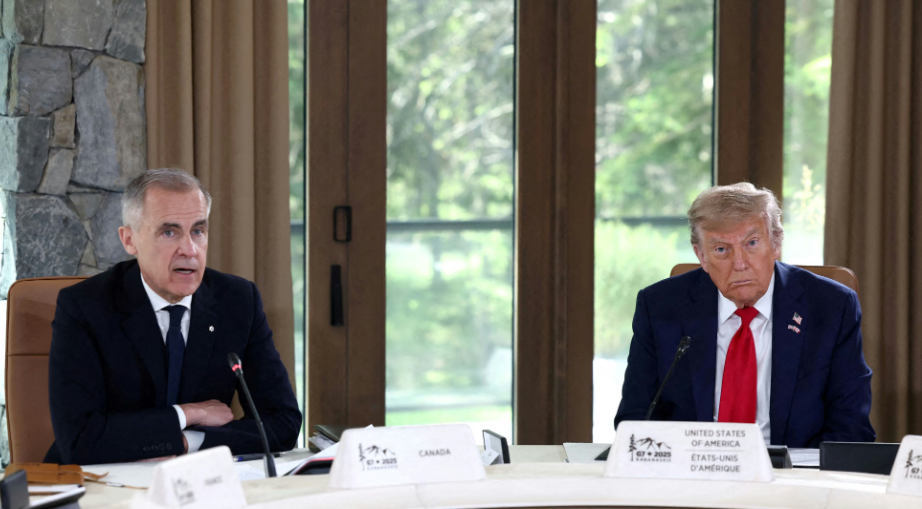
Mark Carney, Canada’s Prime Minister for one year, recently urged middle powers to join Canada in establishing their own path away from high powers such as the United States. On Thursday, January 22, Carney stated the new direction Canada is taking in a speech in Quebec City, stating that the country “must be a beacon.” Speaking to The New York Times, he stated that “the arc of history isn’t destined to be warped towards authoritarianism and exclusion. It can still bend towards progress and justice.” Despite not directly mentioning President Trump, the reference was clear.
Carney’s speech largely dealt with domestic issues. According to the Times, including an effort to “reassure and energize Canadians who have been left angered, exhausted and fearful by Mr. Trump’s year in office…nations should no longer try to get along with Trump.” Trump struck back at Carney by saying, “Canada gets a lot of freebies from us…I watched your prime minister yesterday. He wasn’t so grateful…Canada lives because of the United States. Remember that, Mark.”
Over the past year, Carney and Trump maintained a mostly cordial relationship, but the speech has strained those ties as Canada’s leader signals plans to distance the country from Trump’s United States. Despite a free trade agreement between the two nations, Trump has imposed numerous tariffs that endanger key Canadian industries, such as steel and aluminum.
According to The Hill, on January 19, Trump announced his new “Board of Peace” for resolving “global conflicts,” which he claimed would be “the most prestigious Board of Leaders ever assembled.” Some countries included in this plan are Albania, Hungary, Morocco, Vietnam, and Canada. However, after Carney’s speech, Trump announced on his social media platforms that he will be revoking Canada’s invitation to join.
Carney received an invitation to the Board of Peace last week and was planning on joining. However, according to the Times, “ he quickly distanced himself from the offer after it emerged that Mr. Trump would charge members more than $1 billion in exchange for a permanent seat in the organization.”
Despite Trump not explaining why he was rescinding his invitation, many assume that he is reacting to Carney’s remarks. Months ago, Trump also looked into punishing Canada with even more tariffs because of a Canadian ad quoting President Reagan denouncing tariffs.
Aside from this, Trump has continued to escalate the tension between the U.S. and Canada through policy threats. At different times, Trump has engaged Canada in a trade war, and in another instance, he threatened to annex Canada as the 51st state. This has had the effect of damaging the relationship between the two countries, with many Canadians boycotting American products and choosing not to visit the country. The tension between the U.S. and Canada has also led to uncertainty over the U.S.-Mexico-Canada Agreement, the free trade agreement between Canada, the U.S., and Mexico, which was signed during Trump’s first term in office.
The revocation of the invitation to the Board of Peace by Trump also reflects a larger foreign policy shift in the U.S. under Trump’s leadership. Unlike other international organizations, which encourage cooperation and debate, the board gives Trump complete control over the foreign policy of the U.S. This includes the power to veto, dismiss, and dissolve the organization. This reflects an imperial approach to foreign policy, which Trump has been adopting in recent times.
Overall, the clash between Mark Carney and Donald Trump highlights a turning point in the United States and Canada relations. The breakdown in trade cooperation and international trust shows why Carney believes Canada must no longer rely on the United States, but instead choose its own path forward.