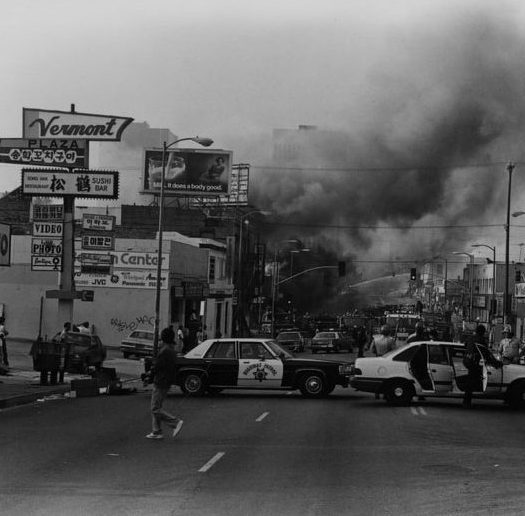
Thirty-four years ago, on April 29, 1992, Los Angeles exploded into unrest. What began as outrage over the acquittal of Los Angeles Police Department officers who had violently beaten Rodney King escalated into one of the most destructive civil uprisings in modern US history. For Korean Americans, though, the event is remembered by another name: Sa-I-Gu, meaning “four-two-nine” in Korean. More than just a date, Sa-I-Gu represents a watershed moment that irrevocably transformed Korean American identity, political consciousness, and civic engagement.
The roots of Sa-I-Gu trace back to March 3, 1991, when King, an African American man, was violently beaten by police during his arrest. Captured on video by a bystander and aired nationally, the footage exposed the brutality and racial inequities embedded in law enforcement. According to History, King suffered dozens of baton strikes, fractured his face, and broke his leg.
Only 13 days later, tensions were heightened when Latasha Harlins, an African American teenager, was shot dead in a grocery store by a Korean shopkeeper on suspicion of shoplifting. The Korean shopkeeper only got put on probation for her crime, causing anger to flare up. For many African Americans, the two cases pointed to a justice system failing to protect all communities.
When the officers in King’s case were acquitted on April 29, 1992, built-up anger finally exploded. Over those five days of civil unrest, 55 people were killed, more than 2,000 were injured, and total damages neared $1 billion, according to KTAR Newsroom.
Korean American businesses suffered significantly during this time. Many Korean immigrants ran small stores within working class neighborhoods, with tensions building with the African American community over several years. Police and law enforcement presence favored wealthier areas of the city while leaving Koreatown unprotected. Emergency calls routinely went unanswered, and residents and business owners were left with no choice but to take matters into their own hands.
In response, many Korean American business owners armed themselves and defended their stores from rooftops, becoming known as the “Rooftop Koreans.” Using Korean-language radio to coordinate supplies and volunteers, they formed a decentralized defense network. Their use of firearms was largely defensive—deterring looters and arsonists rather than seeking violence. Yet despite their efforts, Korean Americans suffered an estimated $400 million in losses, nearly half of the city’s total damage, as stated by NBC News.
Although Sa-I-Gu heavily scarred Korean Americans, it also served as a wake-up call for them. The crisis exposed how a lack of political representation had made the community especially vulnerable, prompting a renewed push for civic engagement and advocacy.
On May 2, 1992, as the unrest largely came to an end, nearly 30,000 people marched through Koreatown in one of the largest Asian American demonstrations in US history. The individuals participating in this march were from varied ethnic groups, including Koreans Americans, African Americans, and Latinos. They called for racial unity, police accountability, and recognition of communities that had long been overlooked.
Over time, Korean Americans would develop greater political representation efforts. Organizational efforts like the Korean American Coalition Los Angeles saw expanded activities relating to voter registration and naturalization. Groups like Korean American Civic Empowerment and the Korean American Grassroots Conference would take hold throughout the nation as Korean Americans organized for greater representation and language access rights.
The reforms that came after the 1992 LA Riots for Korean Americans are not yet concluded even today as many continue to move forward and work on healing their wounds. In 2024, New Jersey Representative Andy Kim made history by becoming the first Korean American elected into the Senate, according to New Jersey Monitor. Most recently, as stated by NBC Los Angeles, former congresswoman Michelle Steel Park was nominated by President Trump to serve as US Ambassador to South Korea.
The legacy of Sa-I-Gu endures beyond the haunted photos of flaming shops and armed men atop rooftops—the newfound civic awareness has truly been instilled throughout Korean Americans across the nation. Such devastation gave birth to a more engaged and organized community determined to see its voice heard and its place within American society properly recognized.