Welcome to the Triple C’s—proof that reading for school can turn into reading for fun (and vice versa). Whether inspired by social media hype, a Barnes & Noble display, a Goodreads email, a syllabus, or pure curiosity, this weekly review is where my honest thoughts end up. Suggestions are always welcome, and the next review is already underway.
It should come as no surprise that the final edition of this column for the 2025-2026 academic year is yet another WWII-centered novel. With shelves at Barnes & Noble constantly stocked with books from the genre, my predilection seems to have no end in sight.
After stumbling upon this novel almost entirely by accident, I found myself pulled into the story of the Kurc family — a family so large and interconnected that even the family tree printed at the beginning of the book barely helped me keep track of everyone.
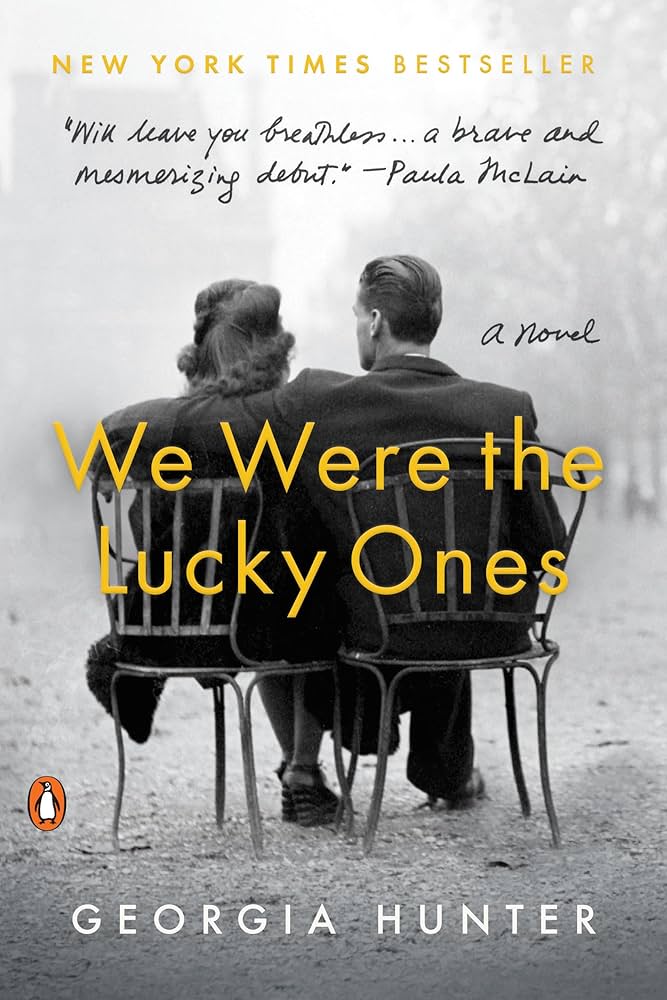
We Were the Lucky Ones by Georgia Hunter is a multifaceted story inspired by Hunter’s own relatives and their experiences navigating the Second World War. The novel begins in March 1939 from the perspective of Hunter’s grandfather, Addy Kurc, one of Sol and Nechuma Kurc’s five children, who is living in France at the outbreak of the war. Separated from his family by borders, conflict, and uncertainty, Addy spends much of the novel desperately searching for signs that his parents and siblings are still alive.
As the Nazis invade Poland and tighten their grip across Europe, each member of the Kurc family is forced onto a different path. Some flee across continents, while others remain trapped in increasingly dangerous conditions. Despite the distance between them, the family clings to hope, relying on letters, memories, and sheer determination to survive.
One unique aspect of Hunter’s writing is the way most chapters begin. Before the story continues, readers are given a brief mention of a major historical event occurring at the time that the specified character experiences. These brief introductions help ground readers in the war’s timeline while emphasizing how quickly conditions were changing across Europe. They also serve as reminders that, although the novel is historical fiction, the events surrounding the characters were very real.
Hunter structures the novel through multiple perspectives, allowing readers to witness the war from several corners of the world. While many WWII novels focus primarily on concentration camps or the battlefield, We Were the Lucky Ones expands beyond those familiar narratives. From labor camps in Siberia to crowded cities in Brazil and hidden apartments in occupied Poland, the novel illustrates just how widespread and disruptive the war truly was.
The shifting viewpoints can occasionally become difficult to follow, especially because of the large number of characters introduced early on, but the emotional connection between the family members keeps the story grounded. What makes the novel especially compelling is the knowledge that it is rooted in Hunter’s own family history. Although the story is fictionalized, many of the events and characters are based on real experiences.
Throughout the novel, hope remains one of its strongest themes. Even as the family faces starvation, imprisonment, displacement, and constant uncertainty, the Kurcs never completely lose faith that they will find one another again. Whether through smuggled letters, rumors of survival, or memories of life before the war, hope becomes the force that pushes them forward. Hunter demonstrates that during a time when so much humanity was lost, holding onto hope was sometimes the only way to endure.
Although the novel spans many years and countries, its message remains consistent: the strength of family can endure even the darkest moments. We Were the Lucky Ones is more than a wartime story; it is a powerful account of survival, resilience, and the unwavering hope of reuniting with loved ones. In the end, the Kurcs truly were among the lucky ones.