Welcome to the Triple C’s—proof that reading, either for school or leisure, can turn into reading for fun (and vice versa). Whether inspired by social media hype, a Barnes & Noble display, a Goodreads email, a syllabus, or pure curiosity, this weekly review is where my honest thoughts end up. Suggestions are always welcome, and the next review is already underway.
Throughout my life, the story of Nazism and the Holocaust has been a continuous theme. From shelves filled with books about the Third Reich, memoirs of Holocaust survivors, and volumes about what it means to be Jewish in my grandparents’ library, I have always known the history of my people.
I have a striking memory of independent reading time in fourth grade. While we had compartments for our own books under the smartboard, I would retreat to the back of the classroom, sliding baskets aside and tucking myself into a small space between the wall and a window. Next to that spot was a basket of historical nonfiction books, and I repeatedly picked up the same one. While I don’t remember the title—or even reading the text—I would stare at the images for the duration of the period. They were black-and-white, gaunt, and haunting: faces I can still see when I close my eyes.
Many novels approach the Holocaust with understandable solemnity, centering clear heroes and villains, suffering and survival. The Paris Architect, however, takes a more unsettling approach. Rather than beginning with moral clarity, it starts in ambiguity, forcing the reader to sit with discomfort before offering redemption, if it offers it at all.
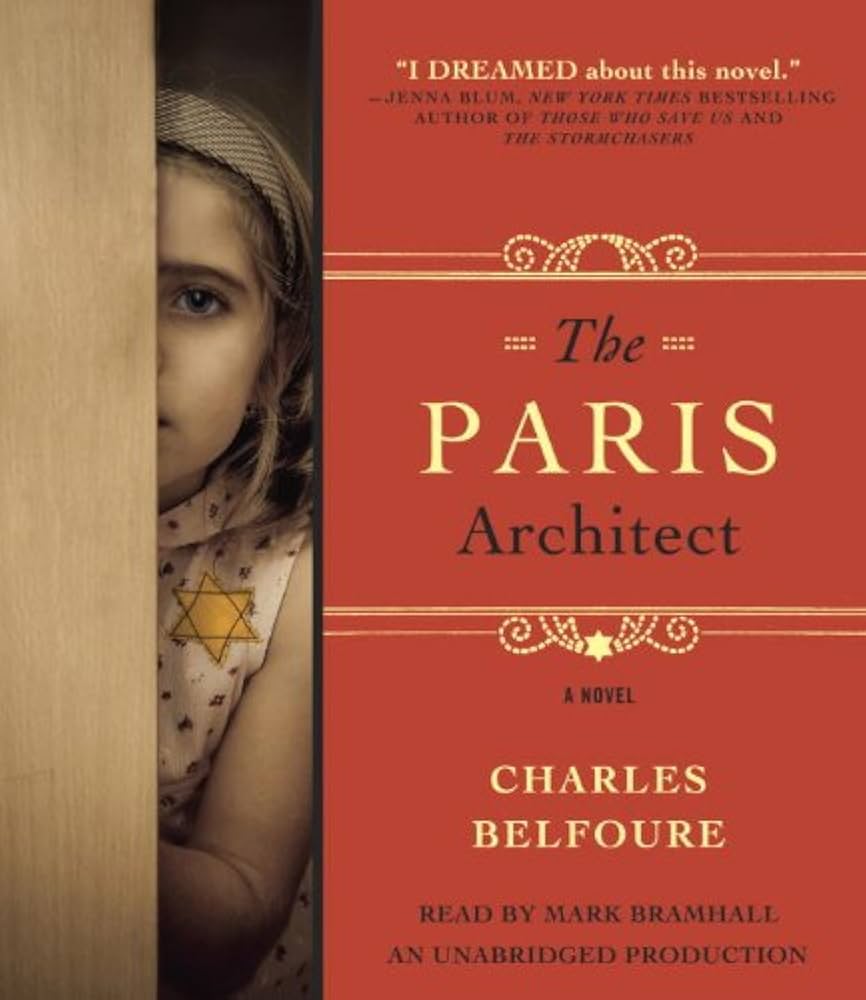
Charles Belfoure’s The Paris Architect is a historical fiction novel that follows Lucien Bernard, a talented but morally detached French architect living in Nazi-occupied Paris. Lucien is not a resistance hero, nor is he initially motivated by empathy or ideology. He is pragmatic, concerned with only money, professional pride, and survival. When he is hired to design hiding places for Jews throughout the city, his participation is purely transactional.
What sets The Paris Architect apart is how it examines complicity. Lucien is neither overtly cruel nor courageously selfless; he is morally grey. As the novel progresses, the hiding places he designs become more dangerous and personal. Architecture—normally associated with permanence and beauty—becomes a tool for secrecy and survival.
The novel’s tension relies not on the various graphic depictions of violence, but the steady cusp of discovery. Every blueprint feels like a gamble layered with consequence. As Lucien witnesses the realities faced by those he hides, his emotional distance begins to fracture. His evolution is slow and uncomfortable, which makes it feel honest and less distant to the reader. Yet, he never considers himself heroic. Redemption is not immediate nor grand, but hesitant, imperfect, and costly.
What makes The Paris Architect especially effective in evoking emotion is its refusal to simplify history. Belfoure does not allow readers to comfortably separate themselves from the past by imagining how they would have acted differently in Lucien’s shoes. Instead, he presents a protagonist whose initial indifference feels disturbingly plausible, quietly asking whether morality is defined by intention, action, or outcome.
The Paris Architect is a novel about the spaces people occupy—physically, morally, and historically. It explores how ordinary skills can become instruments of resistance, and how neutrality, in times of injustice, is rarely neutral at all. While undeniably heavy, the novel lingers not because of what it shows, but because of what it forces readers to consider. History, it reminds us, is shaped not only by those who commit atrocities, but also by those who decide—slowly and imperfectly—to resist them.