When I first learned about New Jersey History Day (NJHD), I had little reason to believe that it would become the most intellectually demanding, but also exciting, experience of my freshman year. Initially, I didn’t consider the competition seriously. As a freshman, I had no prior experience in historical research, no clear understanding of the judges’ expectations, and just a few weeks to prepare. I competed in the Senior Division’s exhibit category against other upperclassmen. My “real” research, if it can even be called that, began only a week before the regional contest. Luckily, I advanced through the regional competition, and by the time I was ready for the state competition, I had gained far more than what I wanted to get out of it—I learned how historians construct theses, analyze evidence, and transform research into narratives.
NJHD, the New Jersey affiliate of National History Day (NHD), asks students to investigate historical topics through papers, documentaries, performances, websites, or exhibits, all tied to an annual theme. The 2026 theme, Revolution, Reaction, Reform in History, was the backbone for my project.
I decided to research the Rooftop Koreans during the 1992 Los Angeles uprising, known within the Korean American community as Sa‑I‑Gu. In summary, I examined how the crisis exposed political marginalization and pushed Korean Americans toward greater civic engagement. (For more about the story, I have also recently written an article for The Echo, commemorating the 34th anniversary of Sa-I-Gu.)
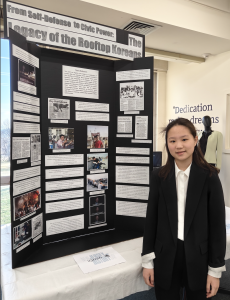
With so little time, the research process was an intense sprint. I moved quickly through newspaper archives, scholarly articles, oral histories, and interviews, trying to extract the most essential material. Turning that research into a coherent exhibit required constant revision—rewriting text panels, cutting sections, and reshaping my argument late into the night. Eventually, I assembled the trifold in the early hours of competition day, exhausted but relieved to have something complete.
Walking into the exhibit hall that morning was both exhilarating and intimidating. Rows of meticulously designed displays stretched across the room, each representing months of dedication and research. As I looked around, I questioned whether my rushed project could even deserve to stand beside them. Furthermore, the judging process itself was equally daunting. Responding to detailed questions from historians and educators required not only familiarity with my sources but also the ability to defend my interpretation of historical evidence. By the end of the day, I felt proud simply to have participated.
To my astonishment, my project had advanced as a state qualifier.
Advancing to states changed my approach entirely. Determined to strengthen my project, I revisited nearly every aspect of my exhibit. I incorporated more primary sources, refined my title, and added more quotes from witnesses. I also worked to make the visual presentation more cohesive and compelling. Still, in true freshman fashion, much of this revision happened during the week preceding the state contest.
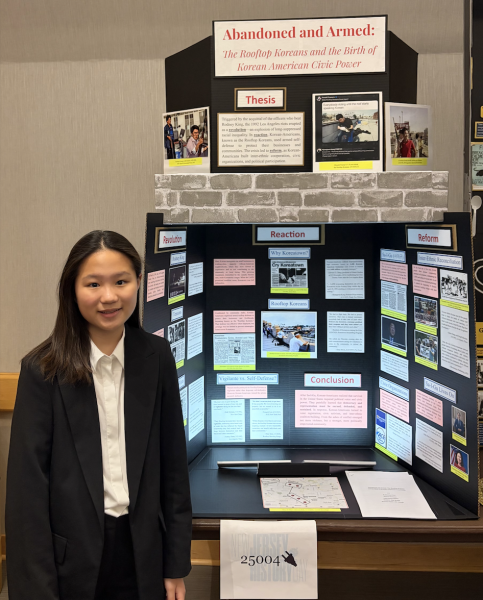
In one word, competition at the state level was extraordinary. The atmosphere was charged with a level of academic intensity that immediately distinguished it from the regional contest. Every student there had already emerged from a highly competitive field, and the quality of the projects reflected that achievement. The exhibits presented were sophisticated, visually compelling, and grounded in extensive research. In my view, walking through the exhibition space felt less like attending a student competition and more like visiting a professional historical conference.
Although I had become more comfortable discussing my research compared to regionals, I remained acutely aware of the caliber of the competition. The experience challenged me to think more critically about historical interpretation and exposed me to an astonishing range of topics, perspectives, and methodologies. Even beyond the judging process, the opportunity to engage with other students who shared a passion for history proved immensely inspiring.
I was not selected to advance to the national contest. However, rather than viewing this outcome as a disappointment, I see it as a testament to how much I accomplished in such a short period of time. In only a few months, I progressed from knowing practically nothing about NHD to conducting substantial historical research, constructing a sophisticated exhibit, and competing at the state level against some of New Jersey’s most accomplished student historians.
The biggest reward that I got out of competing was that the experience altered my understanding of history. It taught me that history is not just memorizing events, but requires the careful examination of evidence, the evaluation of diverse perspectives, and the interconnectedness of every event—one event is always a reaction to another.
In retrospect, what began as a rushed freshman project evolved into an experience defined by intellectual growth, academic curiosity, and personal discovery. Overall, the competition sharpened my research, presentational, and analytical skills while increasing my appreciation of history. Although my NJHD26 journey concluded at the state level, I am already looking forward to competing in NJHD27.