
































































































Snow clung to my coat as I pushed open the doors of the Rockleigh Jewish Home, breathless. Outside was chaotic—snow swirling in tight loops—yet the silence inside was immediate. My hands were stiff from the cold, my nerves still sparking from the frantic drive up from the city.
Rushing to the front desk, I tapped the check-in screen, verified my details, and clipped on a plastic name tag.
“First time volunteering?” the woman at the desk asked.
I nodded, forcing a smile.
Across the lobby, my friend Sienna was waiting. Having grown up with a passion for art, we’d jumped at the opportunity to create an art program for the residents. We named our initiative MAP (Memories Art Program).
My love for art started years earlier with my great-grandmother, who used to sit beside me at the kitchen table teaching me how to draw and mix colors. Ever since then, art has felt personal to me. Walking into the building that snowy morning, I hoped sharing that creativity with others would make the experience meaningful.
Still, as Sienna and I stepped into the elevator, my heart beat a little faster.
When the doors opened, the hallway was quiet except for the low hum of machines. Wheelchairs lined the wall and the faint smell of disinfectant lingered.
Inside the activity room, elders filled nearly every seat around a long table placed in the center. Some sat in wheelchairs while others rested in cushioned chairs, their eyes drifting between the blank paper and the television playing in the corner. A few elders sat along the wall watching, unable to participate.
Standing near the front of the room was Betty, the activity director. She greeted each resident by name and guided them to their seats.
“If you girls need anything at all, come find me,” she said.
Before anyone began painting, Sienna and I stood at the front of the room. The elders slowly looked up from their seats, smiling.
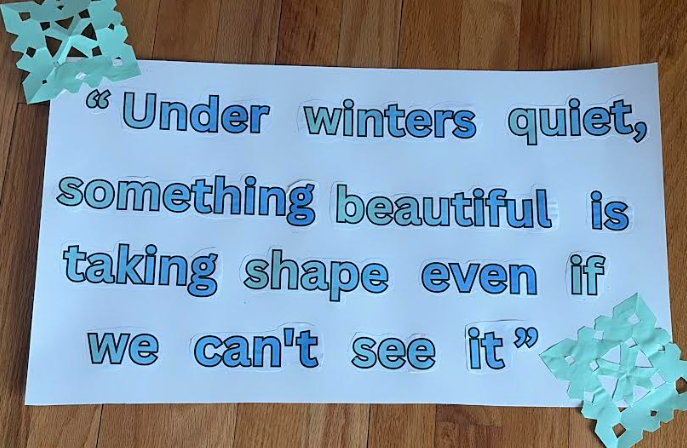
Sienna held up the large printed quote so everyone could read it:
“Under winter’s quiet, something beautiful takes shape even if we can’t see it.”
For a moment the room stayed completely still. Some elders leaned forward to read the words. Others simply stared at the paper.
“We want you to paint whatever this quote means to you,” I explained. “It could be a memory, a season, a place, or something that reminds you of growth or hope.”
A few elders nodded. Others studied the quote, trying to picture what to create.
Betty rolled over a small cart filled with supplies: brushes, cups of water, and paint. Because many of the elders couldn’t reach the materials themselves, Sienna and I pushed the cart around the table.
“Pick three colors,” we told them.
I knelt slightly beside one woman’s chair.
“What colors would you like?” I asked.
She stared at the paints for a moment before pointing.
“Blue,” she said softly. “And yellow,” she added.
As we continued moving around the table, we asked each elder the same question. Some answered clearly while others struggled to speak and pointed to the paints.
While I was circulating to help, a woman suddenly looked up at me.
“Can you help me?” she asked softly. “I know what I want to make, but I don’t know how to execute it.”
“Of course,” I said, pulling a chair beside her.
She looked down at the quote again and read it slowly to herself. She paused, staring at the blank page in front of her.
“To me, it feels like spring is coming. I want to paint a tree. An apple tree.”
Her hands trembled slightly as she picked up the brush, the thin wooden handle shaking gently between her fingers.
Together we began.
I gently placed my hand over hers to steady the brush while she guided where the lines should go.
“Start here,” she said, pointing to the page.
As the brush met the paper, magic unfolded.
“A little higher for the branch,” she said. “And another branch coming out this way.”
We built the tree piece by piece. Each movement was slow and deliberate.
“Now apples,” she said with a smile.
She dipped the brush into red paint. This time she tried placing the brush on the paper herself. Her hand shook slightly, so I steadied her wrist as she added small red circles across the branches.
One apple. Then another. Soon the tree began to fill with color.
When we finally finished, I lifted the paper for her and she carefully studied it.
The tree leaned slightly to one side, and the apples were scattered unevenly across the branches, but the page was full of color.
“It’s not perfect,” she said.
“I think it’s beautiful,” I told her.
She stared at the painting for another moment before turning back to me.
“Please come back again, I love art.”