































There’s a particular afternoon I remember: my brother beside me, the living room steeped in summer’s proclamation of its own fullness. The couch seemed to swallow him in midday light as his copy of New Scientist lay spread across his knees, a landscape of intricate diagrams and a font small enough to sneer at the concept of leisure.
I was scanning without reading, letting my eyes drift the way they do when time feels unclaimed. It was then that I noticed the cat embedded in the article’s margins: shadow pressing against shadow, existing as a question folded in fur.
I couldn’t say why my eyes stayed fixed so long on that cat, or why I traced the curve of its spine as the feline lay folded into the muted darkness of its box. The diagram’s gravity was subtle but absolute, drawing my attention and letting nothing else compete.
“What is it?” I found myself asking my brother, who had now lowered the magazine, looking at me expectantly.
“Schrödinger’s cat,” he explained, “is alive and dead at once. The quantum state of the system encodes both possibilities.”
I frowned, caught in the fog of confusion.
To my disappointment, Schrödinger was not a keeper of cats, but a physicist who, in 1935, imagined a far stranger scene: a cat sealed inside a box with a vial of radioactive substance. Within that vial, a single atom waits, balanced precariously between decay and stillness, for until that atom interacts with something else, it does not choose a definite path. Its uncertainty spreads outward, entangling the detector, the mechanism, and the cat itself. In that suspended state, the cat is not simply alive or dead; it exists in a superposition, the delicate overlap of possibilities that persists until the system is disturbed by the outside world, the moment in which the box is opened.
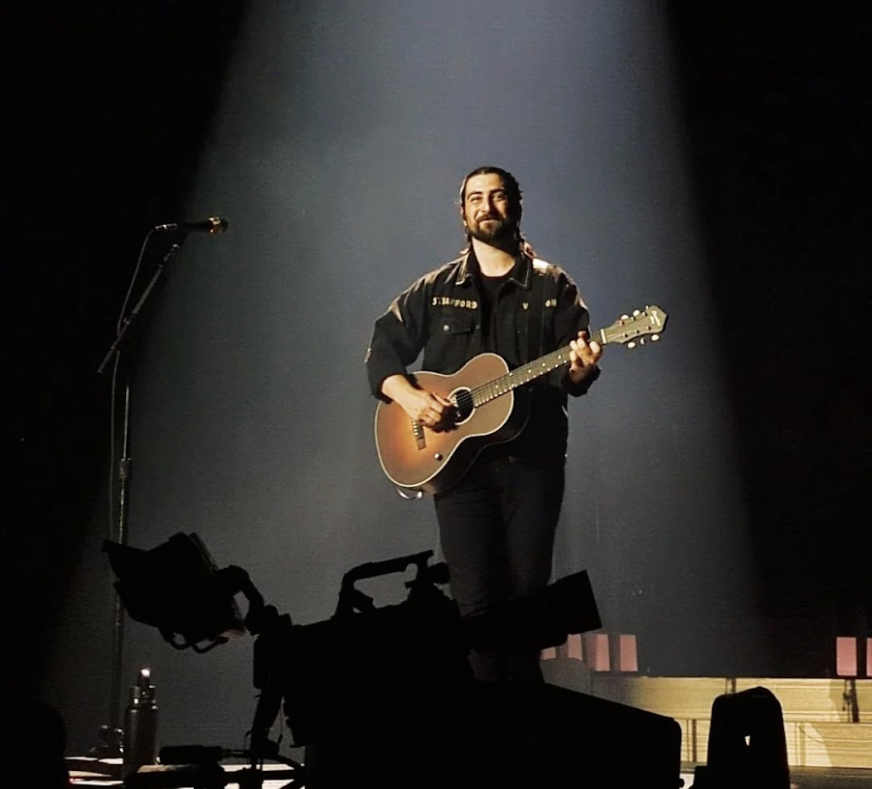
And is it not the same with people? We too exist in overlapping states—sorrow and joy, hope and fear—while the world outside is only ever a shadow of what stirs within. It is impossible, and yet true, that Noah Kahan’s “The Great Divide” lives precisely in that space between what is known and what is hidden. With deft lyricism, Kahan unfolds the distance that grows between those who see each other constantly, but remain blind to one another’s complexities.
His words strike with painful familiarity. After all, to meet someone is to know the simple shapes of a life, never its nuances. They may sit beside you, laugh, then carry on, but the “thoughts that [they] worked overtime to stop” will forever remain suspended in the weightless abyss that is called silence.
Society winds its hands through the hidden folds of ourselves, pressing them into lines and patterns it can bear to see. “The world is scared of hesitating things,” and so the currents of doubt and rebellion live to die in all minds but the one who carries them. Accordingly, it is unsurprising that a child learns early on that “they only shoot the birds who cannot sing,” those who falter under scrutiny and cannot turn fear into something the world will tolerate. Over time, these impulses build an unseen framework, making it impossible to discern one’s struggle: “how hard it [is] to keep it all inside.”
Trapped in society’s box, our inner life pulses unseen, alive only to ourselves and dead to everyone else, making dual existence unavoidable. In that sense, we become the cat.
You should know that only when the box is opened does the superposition collapse. One outcome finally asserts itself—the cat is alive, or the cat is dead.


