

On January 7, 2026, the federal government fundamentally reshaped how Americans are told to fill their plates. In what the USDA is calling a “historic reset,” Health and Human Services Secretary Robert F. Kennedy Jr. and Agriculture Secretary Brooke Rollins introduced the Dietary Guidelines for Americans, 2025–2030. According to Kennedy, this new policy is effectively “ending the war” on saturated fats while completely flipping the famous food pyramid to focus on animal proteins and natural fats.
For decades, the standard advice featured a wide base of grains, breads, and pastas. However, as USA Today points out, the new model turns that old triangle upside down. In this “inverted” pyramid, the most essential categories are now red meat, eggs, poultry, and full-fat dairy. The New York Times reports that this shift demotes the carbohydrates that used to be the foundation of the American diet to a much smaller, less prioritized tier.
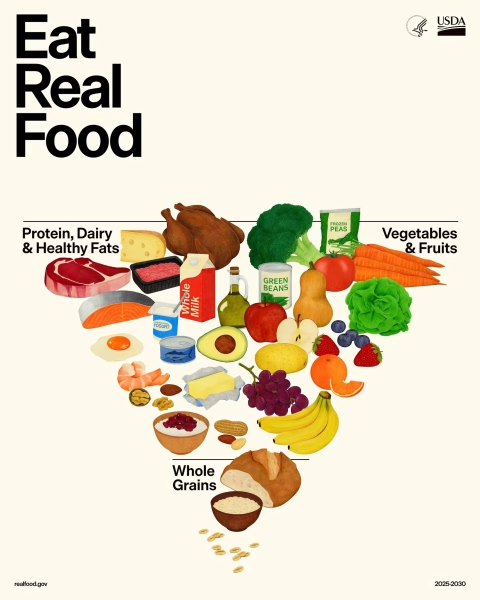
Secretary Kennedy explained during the announcement that these guidelines are meant to return the country to the basics. He noted that American households should prioritize whole, nutrient-dense foods and “dramatically reduce” highly processed items, according to the USDA press release. To support this, The New York Times highlights a significant change in protein recommendations: the government now suggests 1.2 to 1.6 grams of protein per kilogram of body weight—which is nearly double the old standard. Furthermore, NPR reports that the administration is ending the “war on saturated fats,” encouraging people to choose butter and whole milk over seed oils.
One of the most personal changes for families involves sugar. According to The Nutrition Source, the new guidelines suggest no amount of added sugar in children’s diets and a strict limit of 10 grams per meal for adults. This move is a response to a sobering reality: the USDA reports that over 70% of American adults are overweight or obese, and nearly a third of adolescents are living with prediabetes.
Secretary Rollins emphasized that “real food” from American farmers is the ultimate solution to a health crisis that is currently driving $600 billion in annual healthcare costs. While the plan has been welcomed by many in the farming industry, it isn’t without controversy. According to The New York Times, the American Medical Association supports the crackdown on processed foods, but some scientists—like Christopher Gardner of Stanford University—worry that moving away from fiber-rich plants in favor of red meat could lead to different heart health risks.
Ultimately, the “Make America Healthy Again” agenda boils down to a single, simple message: “Eat real food.” Whether this radical change will fix the nation’s health remains a question for us all, but the era of the bread-and-pasta-heavy pyramid has officially come to an end.