






















































































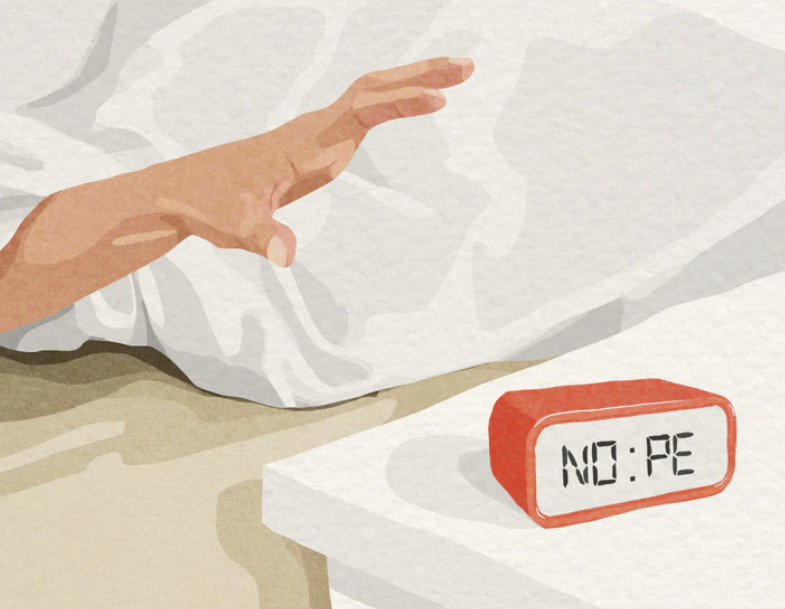
























































As the month of January kicks off, hallways and group chats fill with promises. Students boast about being more organized, managing their stress, being frugal with money, or finally getting their sleep schedule under control. While a New Year’s resolution may come off as something that is expected, even a bore, it is something that we always make every year. It is not coincidental that a resolution that a student picks reveals something about what’s important to that student at that time.
Tenafly students commented on their own resolutions for the New Year, reflecting on what they hope to work on in the months ahead:
“My resolution is to read at least 15 books for fun throughout the year,” Maria Estua-Carrillo (’27) said after a moment of introspection.
“…To go to Alpha Drive One and Chuei Li Yu’s concert,” Jiyoo Choi (’27) said, focusing on the importance of experience.
“To spend my days a little more awake and to notice what actually passes by in the moment,” Soeun Lee (’27) said—just before walking directly into a sophomore.
New Year’s resolutions are also similar on a national level. For students, the typical themes that resolutions will focus on include academics, health, and stability. Improved academics is a popular option as students will always want to raise their grades or better their study habits. Resources directed at students will usually highlight issues such as the importance of students organizing themselves and their academic discipline, themes that one could easily resolve to work on during the month of January, given how closely tied one’s academic success is to their own identity as students.
However, in recent years, these resolutions have started including goals regarding the overall productivity in school. Matters concerning health and wellness are now among the most dominant themes in these resolutions, particularly as the discussion on mental health is growing in intensity by the day. As these new ideas have grown louder, resolutions have shifted toward balance rather than burnout. According to The Post Athens, the goals include mental wellness. This suggests that the resolutions have now moved away from the idea of being gauged on the basis of achievement. This is important since the needs of students involve being healthy in addition to being productive.
Even though the motivation to achieve these goals is quite positive, these students are also aware that if these goals are pursued, it may not be an easy task to accomplish. According to the Pew Research Center, it has been noted that these days, young adults are likely to set goals, but compared to those preceding generations, it is quite tough for them to implement these goals amidst stress. These include, but are not limited to, studies, other activities, and a part-time job.
Statistics further reflect this struggle. Forbes reports that only a small percentage of people successfully achieve their New Year’s resolutions within the year. For students whose routines and environments shift from semester to semester, motivation can weaken just as quickly as circumstances change.
Despite this, these resolutions continue to be relevant as students continue to make them even when they can’t be assured of success because of the fact that they entail reflection. Making resolutions is crucial as they help students take the pause they need for reflection in a system that does not stop for students to reflect.
Perhaps, rather, the strength of the resolutions of students for the coming year is not the precise fulfillment of the resolutions but the intention behind the resolutions themselves. The fact that students have the intention to set resolutions, whether these are related to academic, societal, or personal matters, is an indication that students are actually tackling their own future because, indeed, it seems that the world expects nothing but the best from these bright individuals.