






















































































































































When astronomers first spotted 3I/ATLAS this summer, speculative rumors spread like wildfire across social media: aliens?
The idea wasn’t entirely without precedent. When ‘Oumuamua, the first known interstellar object, was discovered in 2017, its strange shape and motion sparked years of debate. Harvard astronomer Avi Loeb once suggested that “‘Oumuamua could actually be an artificial probe sent by an extraterrestrial civilization.” Now, eight years later, a new interstellar traveler—3I/ATLAS—is passing through our planetary system, and already rewriting scientific expectations.
While speculation about alien origins do make for catchy headlines, astronomers say the most likely result is that it’s a comet from another solar system, carrying geochemical traits of its home world.
3I/ATLAS was first discovered on July 1 of this year by the ATLAS survey telescope in Chile. Within days, scientists realized that the comet followed a hyperbolic orbit, which is a one-way path through the solar system that proves it isn’t bound by the Sun’s gravity.
Tracing its orbit backward, researchers found that 3I/ATLAS entered from the direction of Sagittarius, the constellation that points to the Milky Way’s center. According to TheSkyLive, the comet will reach its perihelion—its closest point to the Sun—on October 30 and pass its closest point to Earth on December 19 at a distance of about 1.8 astronomical units (about 269 million kilometers). NASA emphasizes that the comet poses no danger to Earth, but notes it offers a rare scientific opportunity.
With its path mapped and its trajectory confirmed to be interstellar, astronomers turned their focus from where 3I/ATLAS came from to what it was made of. In August, a team of researchers at Auburn University in Alabama made a discovery that startled astronomers worldwide. Using NASA’s Neil Gehrels Swift Observatory, they detected hydroxyl (OH)—a chemical that forms when sunlight breaks apart water molecules—streaming from 3I/ATLAS.
According to a report from WIRED, findings detailed in The Astrophysical Journal Letters showed that 3I/ATLAS was releasing water vapor at roughly 40 kilograms per second, despite being located in an area of space typically too frigid for ice to turn directly into gas.
“When we detect water—or even its faint ultraviolet echo, OH—from an interstellar comet, we’re reading a note from another planetary system,” Dennis Boewits, an alumni professor of physics at Auburn University, said in a press release.
The team explained that 3I/ATLAS’s activity could be caused by small ice fragments breaking off its surface, which would then sublimate independently under sunlight. This theory, supported by a preprint on arXiv, helps explain why the comet is “leaking water” despite its distance from the Sun.
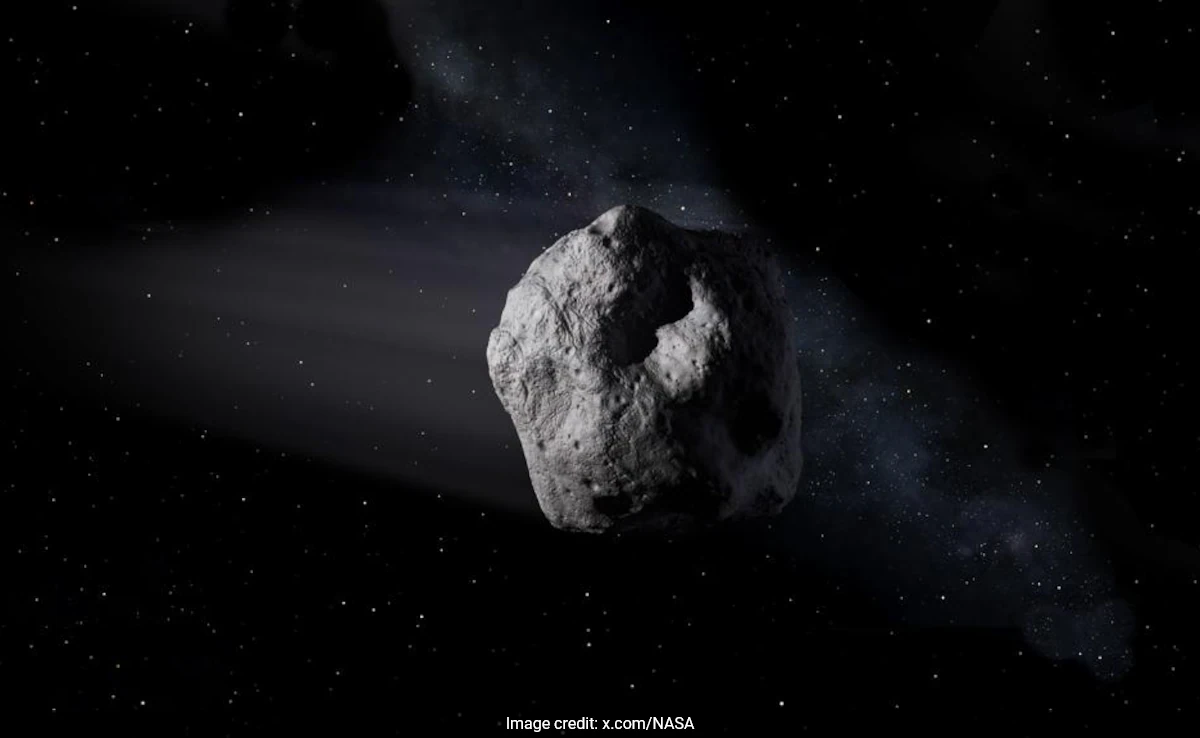
As scientists worked to explain the comet’s unusual activity, telescopes around the world turned their lenses toward 3I/ATLAS to see what this interstellar visitor actually looked like. On July 21, the Hubble Space Telescope captured the clearest image yet of 3I/ATLAS: a glowing teardrop-shaped coma of dust surrounding a faint nucleus. Based on the brightness data, scientists estimate the core’s size to be no greater than 5.6 kilometers and possibly as small as 440 meters.
To astronomers, interstellar comets are cosmic time capsules—the only physical material from other planetary systems that we can observe up close.
“The objects are the first building blocks we can observe from those systems,” Michael Küeppers, a planetary scientist from the ESA, said, according to The Guardian. “They tell us about the conditions in the stellar system where they formed.”
On October 3, 3I/ATLAS made a flyby near Mars, where orbiters such as the Mars Express and the Trace Gas Orbiter attempted to capture its faint glow. The comet will soon slip behind the Sun and re-emerge in December 2025, before exiting the solar system in 2026, as reported by NASA.
Each of the three interstellar objects observed so far has behaved differently. The first, ‘Oumuamua, appeared dry and elongated, while 2I/Borisov was carbon monoxide-rich. Now, 3I/ATLAS is shedding water far from the Sun—another anomaly that forces scientists to rethink how comets form and evolve around distant stars.
Over the next few months, 3I/ATLAS will continue to be observed. The public can track its journey using NASA’s Eyes on the Solar System, an interactive 3D visualization tool showing its path through the inner planets.
Within months, the comet will slip beyond Jupiter’s orbit, vanishing back into interstellar darkness. During its brief passage, it has offered something remarkable: a fragment of another solar system, frozen for eons and now illuminated by our Sun. Whether you see it as just a floating chunk of ice and dust or something far rarer, 3I/ATLAS reminds us that the chemistry of life is not confined to our own sky, but still waiting to be found.