














































































































































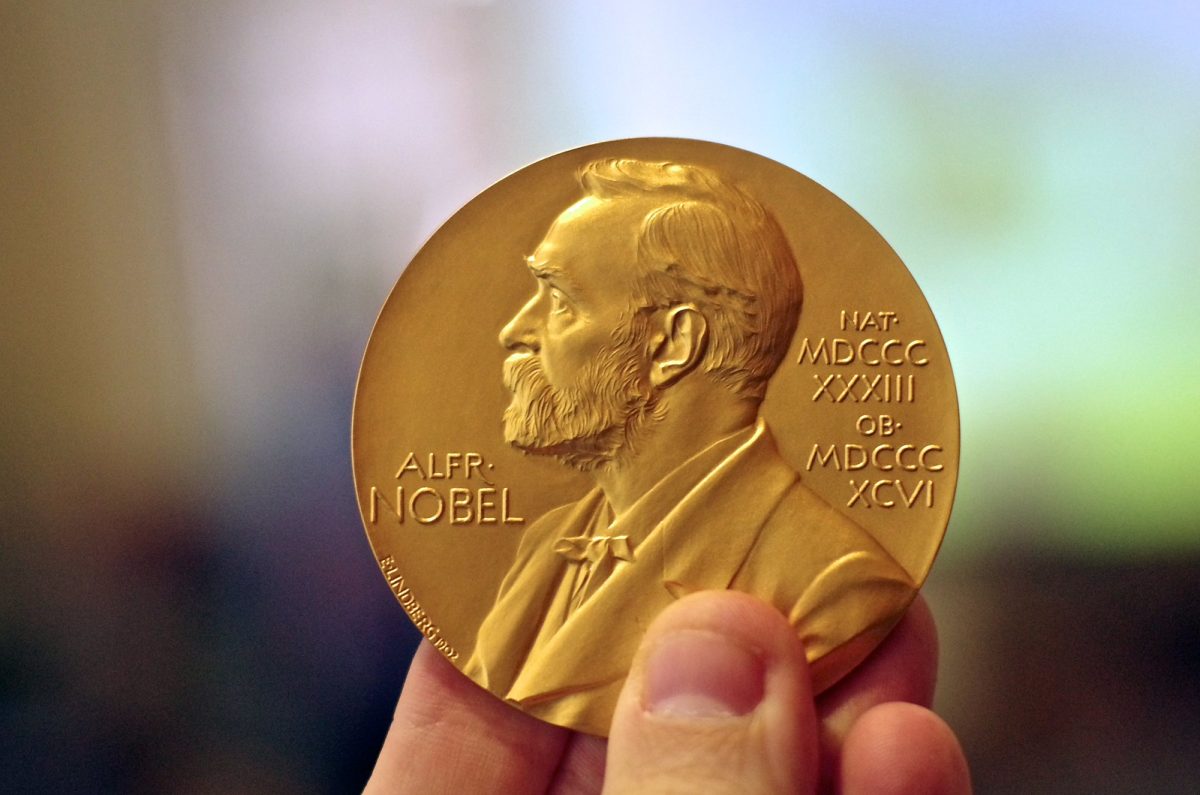
On October 8, the Royal Swedish Academy of Sciences announced Susumu Kitagawa, Richard Robson, and Omar M. Yaghi as the recipients of the 2025 Nobel Prize in Chemistry for their pioneering work on metal-organic frameworks, or MOFs. These groundbreaking materials have revolutionized the way chemists design structures at the molecular level.
Robson, a University of Melbourne professor since 1966, was the first to produce a metal-organic framework in 1989, according to the University of Melbourne Newsroom. Born in 1937 in Glusburn, United Kingdom, he received his PhD from the University of Oxford, as introduced in a press release. However, the structure that Robson first experimented with was weak and unstable.
Fortunately, Kitagawa and Yaghi were able to improve and help stabilize the MOF from 1992 to 2003. According to the Nobel Prize’s press release, Kitagawa earned his PhD from Kyoto University in 1979, where he now works as a professor. He was born in 1951 in Kyoto, Japan. Yaghi, currently a professor at the University of California, was born in 1965 in Amman, Jordan. He received his PhD from the University of Illinois in 1990.
In this new kind of molecular structure, metal atoms serve as nodes and organic molecules containing carbon link them together. The significance of MOFs is that there are large gaps between the nodes and linkers, allowing gases and other molecules to pass through.
The New York Times mentioned two analogies regarding MOFs described by Heiner Linke, chair of the Nobel Committee for Chemistry. The hole inside a MOF is “almost like rooms in a hotel, so that guest molecules can enter and also exit again from the same material.” The structure is like “the handbag used by the character Hermione Granger in the Harry Potter series. The bag looks small on the outside, but has space on the inside to fit larger stuff.”
MOFs have numerous real-world applications in areas that could not have been reached without the invention. The cavities inside make MOFs behave like molecular sponges that capture other materials. For example, according to an article by the Nobel Committee, MOFs can be designed to “absorb” toxic gas during the production of semiconductors. MOFs can also capture water molecules from desert air to collect drinking water. If MOFs trap ethylene gas emitted by fruit, they can also slow down the ripening of fruit. Because chemists can custom-tailor the metal nodes and organic linkers of MOFs to capture specific molecules, the applications stretch across various fields.
This Nobel Prize shows how important the work of Kitagawa, Robson, and Yaghi has been. By transforming a weak and early idea into an innovative creation with many real-world uses, the scientists are helping to tackle problems like air pollution, water shortages, and food waste. Their discovery exemplifies how chemistry can lead to new ideas that improve everyday life.