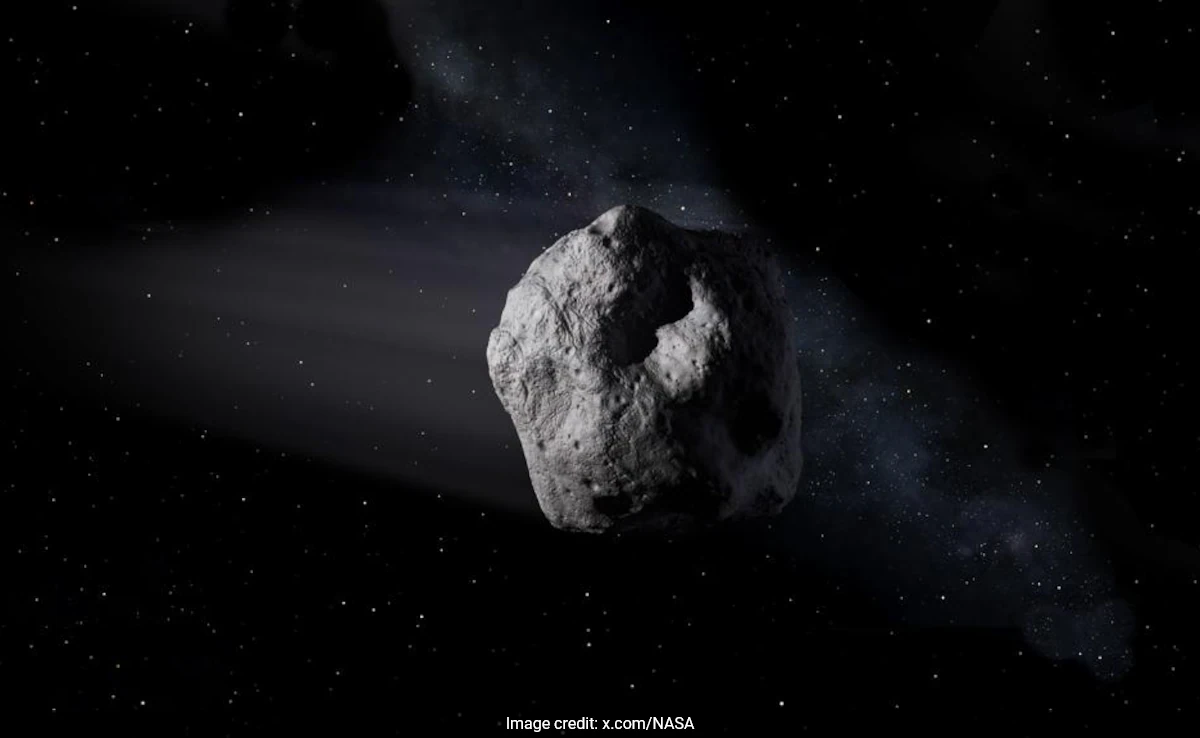























































































































































Say “Hello” to a new space object that appears to be in orbit with Earth. This “quasi-moon,” called PN7, will stick around near us for many decades and is only expected to leave by 2083.
Quasi-moons, like PN7, are not true moons and are much smaller than the Moon. PN7 is really an asteroid that follows an extremely similar orbit to Earth’s, but its path is more elliptical. As a result, this gives the illusion that PN7 is orbiting the Earth from our view on the ground as its position relative to Earth changes as both objects travel around the Sun. However, PN7 is simply orbiting the Sun, not Earth, in an oval shape.
According to Zoe Ponterio, manager of Cornell University’s Spacecraft Planetary Image Facility, who described its motion on ABC news, the orbit would be faster when closer to the sun and slower when it’s farther as it follows its oval path. This contributes to the orbiting illusion, and when the Earth and quasi-moon take “turns passing each other, the quasi-moon appears to be moving around [Earth].”
PN7 sadly won’t stay with the Earth forever. Phil Nicholson, a professor of astronomy at Cornell University, provided ABC News with an analogy to describe the situation. He compared PN7 to a wolf that may follow a band of hunters scavenging their leftovers. The wolf never truly joins the group just like PN7 isn’t truly joining our solar system. Eventually, the wolf would leave on its own and so would the quasi-moon. But this asteroid is nothing new. Earth has had many of them throughout its lifetime. Some of them last only a couple months, while others can span several years before they depart. In 2024, for example, there was a “mini-moon” that entered Earth’s orbit for only two months.
Unfortunately, PN7 is not visible to the naked eye. Ponterio describes it as “far too small, dark, and distant.” It was discovered at the Haleakala Observatory in Hawaii using the Pan-STARRS telescope when it took photos on August 29. However, even older data may suggest that PN7 has actually been in our solar system for 60 years already.
There are a multitude of reasons why scientists are so interested in quasi-moons. The Planetary Society explains that these moons can come from so many different places, and understanding how they got so close to Earth can be beneficial in understanding how other asteroids might be a threat to Earth. This is imperative as many fear the harm that asteroids may inflict on us. As scientists research ways to destroy asteroids before they get too close, these moons can provide crucial information on what the best way to save ourselves might be.
Mini-moons like PN7 are the subject of many missions. These missions help researchers understand more about the moons and what they are made of. Different moons have been known to have been made of different minerals and metals. By finding out about what they are made of, we can better understand the universe and what else might be out there.
Although PN7’s time with Earth is temporary, it showcases how dynamic and changing our solar system is. Each quasi-moon that passes near Earth offers an opportunity to study the balance of gravity that shapes our universe. For now, PN7 will accompany the Earth on its long journey around the Sun, a small unseen hitchhiker that will share our orbit until it finally drifts away in 2083.