

























































































































































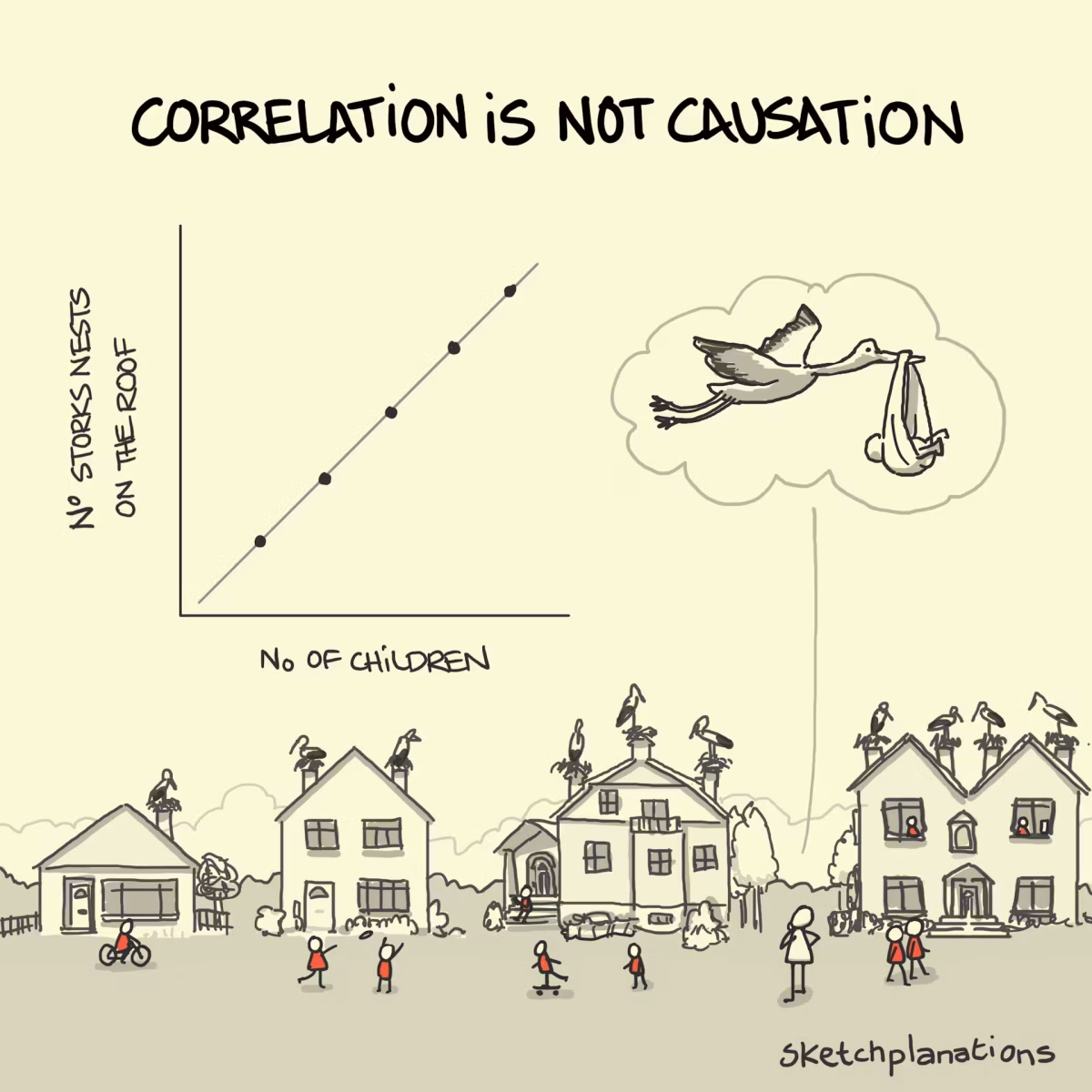
You may have heard the phrase, “correlation does not imply causation.” This warning is often repeated in fields such as science, statistics, and even business. But what exactly is correlation and causation? The two words sound similar, but can lead to very different conclusions.
“Stop confusing correlation with causation,” the Harvard Business Review wrote in 2021. That advice wasn’t directed towards high schoolers but to business leaders, indicating the extent of the confusion between these two words. Let us clarify these concepts and explore the role of confounding factors, which often appears in the discussion of cause and effect. We will also examine a recent controversy on the use of Tylenol during pregnancy and autism, where a misunderstanding of these ideas can have serious consequences.
Suppose you notice that event A tends to happen after event B. Naturally, you might ask if they are connected or not. Correlation means that two things tend to happen together. An example would be that rain in Tenafly and traffic congestion at Tenafly High School (THS) in the morning are positively correlated. On the other hand, causation means that one thing directly makes the other thing happen, with one being the cause and the other being the effect. In the previous example, the rain actually increases the traffic because more parents drive their children to THS when it is inconvenient to walk or bike to school. As you might have guessed, causation is a much stronger claim than correlation; causation implies correlation, but not the other way around.
Then, what can be an example of a correlation that is not a causation? A classic example is the relationship between shark attacks and ice cream sales. Data collected each month would show a strong positive correlation between these two events; in the months with high ice cream sales, there would also be frequent shark attacks reports. But does it mean there is causation between the two? Does ice cream attract sharks? Or do shark attacks make people consume more ice cream?
The answer is no for both of these questions. This is where confounding factors come in. According to the Merriam-Webster Dictionary, to confound means “to throw into confusion” or “to mix up,” which is effectively synonymous with the word confuse. In science, a confounding factor is a third variable that affects both events in the question. In the ice cream and shark example, the confounding factor is hot weather! Hot weather in summer months increases ice cream sales and sends more people to the beach, where shark attacks happen. The confounding factor is what confuses us by making it look like one event is responsible for causing the other. That is why a popular mnemonic, “confounding” as “confusing the findings,” makes perfect sense.
Identifying a confounding factor is essential for understanding a true relationship, as well as for avoiding false conclusions. But it is not easy; confounding factors are often hidden and hard to measure. That is why proving causation is much more difficult than observing correlation.
This September, President Donald Trump and the Health and Human Services Secretary Robert F. Kennedy Jr. warned against the use of Tylenol during pregnancy, citing concerns over a potential link to autism in children, according to the BBC. Autism, or autism spectrum disorder (ASD), affects communication and behavior, and its causes are still being studied. Tylenol, meanwhile, is one of the most widely used over‑the‑counter pain relievers, according to the Wikipedia page of Tylenol .
A study published in The Journal of the American Medical Association in April 2024 examined this very question. In the first analysis, where data from 2.5 million Swedish children born between 1995 and 2019 were used, researchers found a slightly higher rate of intellectual disabilities, including autism, among children whose mothers reported using Tylenol during pregnancy.
At first glance, this suggests a correlation. But, in the second analysis, where the researchers compared siblings born to the same parents when one had been exposed to Tylenol during pregnancy and another had not, the correlation disappeared. The two groups of children, regardless of Tylenol use, had the same probability of being exposed to autism. This finding strongly suggests that the correlation in the first analysis was due to a confounding factor, although they could not pinpoint what it was. To put it another way, taking Tylenol did not cause autism.
President Trump and Secretary Kennedy’s claim confuses correlation with causation, much like blaming ice cream for a shark’s attack. Since the initial comments, Secretary Kennedy had softened his stance.
“The causative association… between Tylenol given in pregnancy and the perinatal periods is not sufficient to say it definitely causes autism,” said Kennedy, according to USA Today.
This event highlights a bigger issue: even with significant science research, correlation and causation are often misunderstood—even by leaders at the federal level. These concepts are foundational to scientific inquiry, and conflating them risks misleading conclusions. As Carl Sagan, the astrophysicist and science author, famously said, “extraordinary claims require extraordinary evidence” in his book Broca’s Brain. Until strong causal proof emerges, it is important to approach such claims with careful skepticism and a clear understanding of correlation and causation. Only then can we make informed judgements that reflect scientific truth.