
















































































































































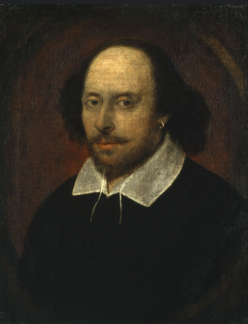
“All the world’s a stage, and all the men and women merely players.” This widely recognized line from Shakespeare’s As You Like It reveals more than meets the eye—where Shakespeare is the puppeteer and we are a part of his grand performance.
Almost every English student has encountered a work of Shakespeare: Hamlet, Romeo and Juliet, and Macbeth are all household titles. But despite his renown, Shakespeare’s credibility is heavily disputed by Anti-Stratfordians.
Upon further investigation, evidence points more away than towards the renowned writer. Although he masterfully crafted plays, tragedies, histories, and comedies in his lifetime, his parents and children were completely illiterate. History.com explains, despite his promotion of women in The Merchant of Venice and Much Ado About Nothing during a time of dominating patriarchal structures, that he never concerned himself with educating his own daughters. Inspection of his work revealed a total of six signed signatures throughout the course of his life—three incomplete and three on his will, but all crude, demonstrating a difficulty in writing his own name.
Shakespeare was not an honest man, and his financials mirror this characteristic. On multiple occasions, he was accused of being a grain hoarder, taking advantage of the devastating famine by reselling grain at substantially raised prices. He began a money-lending system while evading taxes, taking property and land as “collateral” from those who were unable to repay him. Shakespeare was a ruthless businessman, a shareholder in Lord Chamberlain’s men (the company that performed his plays), and an actor, all while writing 154 sonnets and 38 plays.
Here is what we know so far: Shakespeare was miraculously literate, had difficulty writing his own signature, exploited grain for money, and was terrible at paying his dues. If his story isn’t seeming suspicious to you by now, the actual content of Shakespeare’s work will surely raise your doubts.
The final piece of evidence to close his case is perhaps the most important—one would expect a writer to place his work in the field that he is best accustomed to. However, the Harvard Magazine indicates that Shakespeare detailed locations with no record of his visiting. There is no evidence that he left Stratford-upon-Avon, Warwickshire, until he was in his twenties, well after his establishment in the theater world.
Despite his limited travels, he was well-versed in French, Danish, and Italian names, politics, customs, language, and culture. Shakespeare never visited Italy but found great joy in detailing Italian weddings, as highlighted by Jodi Picoult’s By Any Other Name. In Two Gentlemen of Verona, he mentions interior frameworks of canal systems that were only known to locals and references a geographically specific and accurate sycamore grove in Romeo and Juliet.
While Shakespeare maintained several professions, there is no record of him receiving any medical, musical, or legal training. However, across his plays, he uses a hundred musical terms and over two hundred plants. He wrote extensively about the law despite never setting foot into the court and humanized Jews during a time when anti-Semitism was prevalent.
If Shakespeare wasn’t the true author of his plays, who was? Several theories have pointed to three main figures.
The first is Edward De Vere, the 17th Earl of Oxford. A patron of the arts and literature, he sponsored acting troupes and toured a majority of Europe. His story is mirrored in Shakespeare’s Hamlet—De Vere was captured by pirates and left on the shores of England, similarly to Hamlet in Denmark. At the time, he was a highly influential nobleman. Publishing pieces under his name, critiquing others in the court would cost him his profession, if not his life.
A second alternative writer is Francis Bacon, a philosopher and lawyer who wrote under alternate names. In 1626, Manes Verulamianum was published, featuring several eulogies by writers referring to Bacon as a “concealed poet” and using unique analogies only found elsewhere in reference to Shakespeare himself.
The final contender for the famous playwright is Mary Sidney Herbert—the first woman to publish a play in English. One of the most educated women at the time and fluent in Latin, French, and Italian, she was proficient in all the areas found lacking in Shakespeare: medicine, hunting, alchemy, and court life.
Despite the controversies surrounding Shakespeare’s origin, the quality of his writing isn’t impacted. From complex familial dynamics to protests in religious rights, his writings will continue to be studied across the decades for years to come.