




















































































































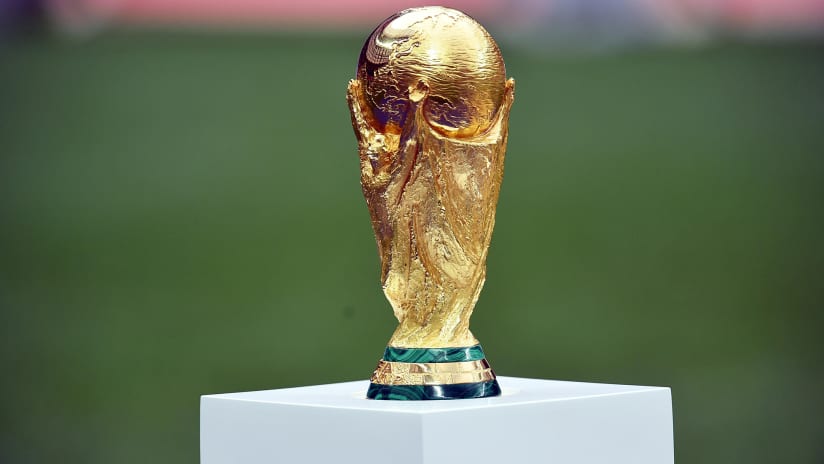
With qualification for the 2026 World Cup in the USA, Canada, and Mexico nearing its end and the groups being drawn, many fans are discussing how this upcoming tournament will be different from past editions. Not only is the tournament expanding from 32 to 48 teams, but it will also have three host nations for the first time in history. The only time there was more than one host country was at the 2002 World Cup in South Korea and Japan. Now, there are 16 different stadiums in three countries: 11 in the USA, three in Mexico, and two in Canada, according to FIFA. This upcoming World Cup will be unique, with so many new aspects to watch for.
Forty-two teams have already secured their spot at the tournament next summer, with six places still up for grabs. Four of these will come from European teams qualifying through UEFA playoffs, and the last two will make it through international FIFA playoffs. Many big nations in the soccer world have already qualified, including five-time World Cup winners Brazil, featuring Neymar; 2018 champions France, led by Kylian Mbappé; 2022 winners Argentina, captained by Lionel Messi; 2024 Euro champions Spain, featuring Lamine Yamal; and 2025 Nations League winners Portugal, captained by Cristiano Ronaldo.
Meanwhile, some nations have made it for the first time in decades, while others have qualified for the first time in history. Four countries will be participating in their first World Cup next summer, according to BBC. These are Cape Verde in Africa, Curaçao in North America, and Jordan and Uzbekistan in Asia. It is important to note that Curaçao is not an independent nation; it is an autonomous country within the Kingdom of the Netherlands but still has its own national team. A few more teams in the playoffs can still qualify for their first World Cup, including Suriname in South America.
For the first time in history, there are 12 groups of four teams in the tournament. Each team plays every team in its group once, earning three points for a win and one for a draw. The top two nations from each group move on to the round of 32, along with the eight third-place teams with the most points. After this, it is a single-elimination tournament until the final, where the winner is crowned World Champion. There is also a third-place game between the losers of the semi-final matchups.
There will be four additional groups in next year’s tournament, bringing the total to 16 teams, leading to many interesting matchups. For example, the opening game between Mexico and South Africa is a rematch of the 2010 World Cup opener, according to ESPN. The U.S. has been drawn into a group with Paraguay and Australia, with either Kosovo, Romania, Slovakia, or Türkiye getting the last spot.
Of course, despite a few places still up for grabs, there is much debate over which group is the “Group of Death” for this upcoming tournament. The “Group of Death” is a title given to a group featuring many strong teams and high-level competition. A team’s strength is measured by its FIFA ranking, a global leaderboard of all national teams, which is determined by each team’s performance. According to Fox News, the group with the best average FIFA ranking is group F, consisting of the Netherlands, Japan, Tunisia, and a UEFA playoff winner still to be determined, making it mathematically the “Group of Death.” Groups I and L are arguably among the most difficult, with Group I featuring France, Senegal, Norway, and a FIFA playoff winner, and Group L consisting of England, Croatia, Ghana, and Panama.
The real big question everyone is asking is whether adding 16 teams to the tournament is a good idea.
“I believe that 48 teams is the right number,” FIFA’s Chief of Global Football Development and former Arsenal manager Arsène Wenger said to ESPN. “It’s less than 25% for 211 countries who are affiliated to FIFA. I’m quite optimistic, because to qualify you need to beat the teams of your confederation, and that’s a sign of quality, it’s just down to results.”
Ultimately, the most important part of the World Cup is cheering for your home country and connecting with other fans. Whether you’re rooting for a footballing giant like England or an underdog like South Africa, we’re all sure to witness some magical moments at next summer’s tournament.