















































































































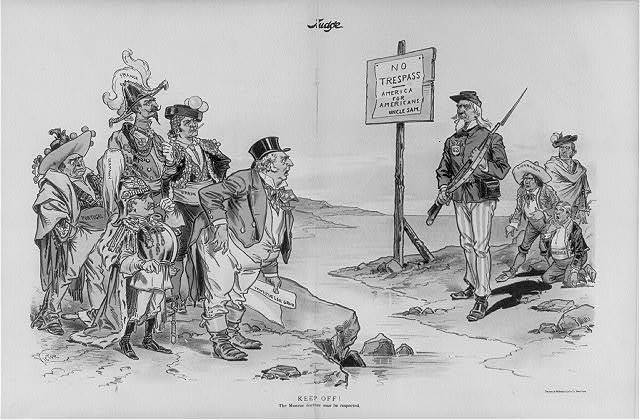
On December 2, 1823, the United States introduced a new policy that would go on to shape the entire world: the Monroe Doctrine. This policy was announced in 1823 by the fifth president, James Monroe, during one of his messages to Congress.
During the 1800s, the world looked very different from today. According to History, many Latin American countries had just won “their independence from Spain or Portugal…and the United States worried that the powers of continental Europe would make future attempts to restore colonial regimes.” As a result, the young US, still finding its place in the world, wanted to prevent that from happening. The Monroe Doctrine stated that the Western Hemisphere was no longer an option for European colonization and that any attempt would “be seen by the United States as a threat to its security.” In return, the United States promised not to involve itself in any European conflicts. Originally, this policy was made to protect America and other newly founded independent nations.
However, as time passed, the Monroe Doctrine evolved from a measure intended to protect others into one that was used to justify U.S. intervention. In 1904, President Theodore Roosevelt introduced something called the Roosevelt Corollary, which stated that the US had the right to intervene in Latin American countries if instability in the region threatened American interests. This expansion changed the Monroe Doctrine into a tool that allowed the US to act as a policing nation. According to PBS NEWS, President Trump’s recent usage of the Monroe doctrine has reminded people of the past when President Roosevelt, “claimed that the Monroe Doctrine could be extended to justify interventions that instead of defending Latin American nations from European intervention, policed them to make sure their governments acted in U.S. commercial and strategic interests.” The history behind this doctrine helps explain why the Monroe Doctrine still appears today, which is most recently being used by President Trump.
Recently, Trump explicitly referenced the doctrine when discussing US policy toward Venezuela, particularly in opposition to the government of Nicolás Maduro. He argued that Venezuela was “increasingly hosting foreign adversaries in our region and acquiring menacing offensive weapons that could threaten U.S. interests.” Trump’s continuous use of the Monroe doctrine shows the reemergence of a doctrine that will change the world. WDTV reported that President Trump had stated that we “sort of forgot about it,” but after the recent events, “We don’t forget about it anymore.” This statement made by President Trump reinforces the idea that the US still and will claim authority over foreign influence in Latin America. The continued relevance of the Monroe Doctrine raises major questions on American power and its responsibility. A policy originally created to protect the US from foreign countries has changed into something that is being used to justify US intervention. More than 200 years later, the Monroe Doctrine remains a reminder that the past still influences the present and that foreign policy decisions today are often rooted in ideas formed long ago.