



































































































































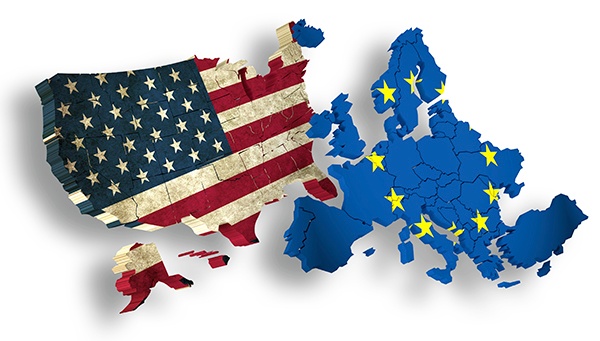
President Trump abruptly cancelled his tariff threats against eight European nations Thursday, claiming he reached a “framework” for a deal on Greenland. Markets rallied, but for those watching the underlying data, the crisis is far from over, as this week’s whiplash is likely to create more long-term problems than it will solve.
What Actually Happened
The timeline of this crisis is critical. On January 18, Trump threatened 10% tariffs on Denmark, Sweden, Norway, France, Germany, the Netherlands, Finland, and the UK unless they facilitated a US purchase of Greenland. In response, the European Parliament suspended the Turnberry trade deal on January 22, a deal originally signed in 2025 to stabilize trade, while preparing $108 billion in retaliatory tariffs targeting American products from bourbon to Boeing aircraft.
The sudden reversal followed a meeting with NATO Secretary General Mark Rutte. While the tariffs are currently off the table, no concrete agreement has been signed. Danish and German officials remain vague on the details, leading one professor to call it a “pretend deal” designed to save face.
The Rise of European Strategic Autonomy
The most significant fallout is the “great pivot.” European leaders are no longer waiting for the next US threat; they are actively cutting dependencies to achieve “strategic autonomy,” the ability to act without being vulnerable to U.S. pressure.
Just this week, the EU and Mercosur signed a landmark Partnership Agreement, creating one of the largest free trade zones in the world with 700 million consumers. By linking with South America, Europe is building a backup plan to replace US trade. Simultaneously, European officials are rushing to finalize an EU-India Free Trade Agreement to find new manufacturing hubs and consumers outside of Washington’s influence.
Bond Markets Signal Deeper Concerns
While the stock market rebounded quickly, Treasury yields tell a different story. The 30-year yield spiked above 4.90% during the crisis and has not fully retreated. Bond markets are typically more forward-looking than stocks, and persistently high yields suggest investors are pricing in a permanent “geopolitical risk premium,” essentially demanding a higher return for holding assets in a riskier world.
Higher Treasury yields translate directly into higher borrowing costs. Mortgage rates, corporate debt, and consumer loans all price off this “risk-free rate.” A sustained increase of even 20 to 30 basis points (0.2% to 0.3%) represents billions in additional interest costs. Deutsche Bank analysts highlighted that the deep financial integration between the US and Europe creates systemic risks; a serious rupture could trigger disruptions in capital flow in both financial systems.
Why Europe Remains on Guard
Europe has not yet lifted its countermeasures. The Turnberry deal suspension remains in effect, and the $108 billion retaliation package stays ready. France, in particular, is pushing for the activation of the Anti-Coercion Instrument (ACI), a “trade bazooka” that allows the EU to block market access or investments from countries using economic blackmail.
Even Germany, typically cautious, maintains that red lines were crossed. Unified European resolve signals low confidence in the “Greenland framework.” This matters because it keeps business uncertainty elevated. Companies must now factor in a meaningful probability of future disruptions, leading the EU to double down on its Critical Raw Materials Act to secure the lithium and rare earths needed for technology without relying on US-controlled supply chains.
Quantifying the Uncertainty
The challenge for analysts is quantifying costs from threats that never materialized. However, academic research shows that uncertainty effects can equal or exceed the impact of actual tariffs.
Consider the practical implications: European automakers planning US factory investments now face elevated risk that trade conditions could shift rapidly. American agricultural exporters must hedge (spend money to protect) against potential retaliatory measures. These costs represent real, costly economic losses.
Geopolitical Implications
This episode accelerates trends in geopolitical economics. China has observed carefully as the US and Europe came close to conflict. Beijing’s strategic objective of reducing Western economic coordination just received unintentional assistance.
For investors, any movement toward European autonomy represents a structural shift in global trade. As EU foreign affairs chief Kaja Kallas noted, adversaries benefit from Western alliance friction. This translates to reduced coordination on China policy and a potential divergence in technology standards as Europe seeks its own path.
Market Outlook
Looking ahead, markets face two scenarios. In the optimistic case, policy uncertainty gradually declines. Even this scenario leaves permanent scars in the form of reduced transatlantic business confidence. The pessimistic scenario sees renewed tensions validating European concerns and triggering the prepared countermeasures.
Either way, while the Greenland economic crisis may have paused, its aftershocks are just beginning.