















































































































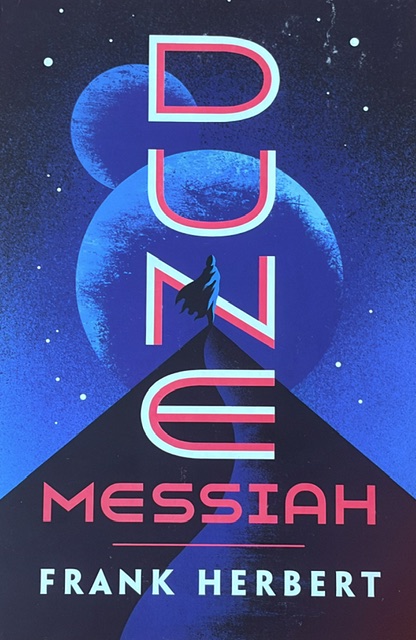
In March 2024, Dune Part Two came out and marked the beginning of my Dune fixation. I immediately went on to read the novel that correlates with the first two movies—Dune by Frank Herbert—and it went on to become one of my favorite novels of the year. I had yet to find a science fiction novel that captures the same feeling that Dune did. But still, I had no desire to read any of the sequels, being content with the ending of the first installment. That was, until the trailer for the third movie was released. The character, the fight scenes, and the war chants all reignited my obsession with the franchise. I couldn’t help but instantly read the accompanying novel. Despite the negative reviews for the short sequel, Dune Messiah might be my favorite book of the year, just like its predecessor.
The first Dune book follows Paul Atreides as he rises to power and becomes a savior or messiah to the people of Arrakis. To amass further control over the reigning houses, he takes the hand of Princess Irulan in marriage and leaves his lover, Chani Kynes, to be a concubine. Dune Messiah continues Paul’s story more than a decade after those events. The older Paul struggles to maintain his power, protect his loved ones, and avoid becoming a tyrant.
Despite my immense excitement to jump back into the Dune world, I was highly intimidated. While I love the first book, it was slow-paced and took me close to two months to complete. However, my worries were unfounded because Messiah was extremely fast-paced. I couldn’t put the book down, and ended up finishing it in three days.
Moreover, I found Herbert’s magnificent prose and use of themes just as good as his series debut. Where the first novel follows the hero’s journey and intertwines themes of oppression, the pursuit of power, and the dangers of religion, the second book exhibits similar motifs. Except this time, Paul is painted more as the villain than as the hero. Until now, readers of the books and viewers of the films have seen Paul as someone to root for. Yet Messiah was precisely written by Herbert to challenge those ideas.
“When Frank Herbert wrote Dune, he was disappointed at how people perceived Paul,” Denis Villeneuve, director of the Dune films, said in an article on Entertainment Weekly. “In his mind, Dune was a cautionary tale—a warning against charismatic figures.”
Notwithstanding my praise for the novel, I do partially understand the criticism this book receives. Messiah is often referred to as a long epilogue to the first Dune book. That is evident throughout the whole book. Messiah doesn’t stand on its own as a part of an epic saga, nor does it have a complete or traditional story arc. Regardless, I found I still enjoyed this book and the uniqueness of it.
Concerning whether the adaptation will be accurate to its source, in some aspects it likely will, yet in others, I don’t understand how it could be. The first two movies were very book-accurate as they portrayed almost every scene and dialogue from the book, and represented the same themes. I trust that Dune: Part Three will also have a myriad of scenes and dialogue taken from the book, and will depict the cautionary-tale theme. Yet when watching the trailer, there were numerous battle scenes that were never once depicted in the literary work, and the character of Lady Jessica never appears once in the book, but she does in the trailer.
Most importantly, one of the biggest inconsistencies between the book and the movie is the relationship between Chani and Paul. On screen, Chani is fiercely independent and strong, and she never shies away from challenging Paul. In the book, Chani is significantly less strong-willed than on screen. Personally, I prefer the film’s interpretation because it’s more fitting of modern ideals about feminism. However, this change can make adapting Dune Messiah difficult, since Chani’s loyalty and actions are central to Paul’s motivations throughout the novel about protecting her.
Ultimately, regardless of how much Dune: Part Three may differ from its source material, I still trust Denis Villeneuve to deliver a compelling adaptation. The first two films were phenomenal, gripping, and faithful to the spirit of Herbert’s work, even when they changed aspects of the story. I highly recommend reading the Dune saga if you love the movies as much as I do and are an avid sci-fi or fantasy reader.