







































































































































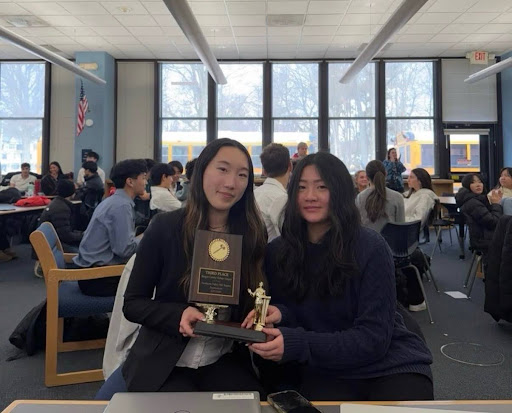
The art of argument—the ability to navigate a sea of perspectives and emerge with a refined logic—is a notorious challenge, often requiring a level of research and quick-thinking that can catch even the most prepared students off guard. True to the spirit of intellectual rigor, the Tenafly High School Debate Club proved that their voices are as sharp as their minds with a standout performance this past month. On February 6, Co-Vice Presidents Claire Yoon (’28) and Emma Chai (’28) rose to the occasion, placing third in the Varsity division of the Bergen County Debate League Tournament, held at Northern Valley Regional High School at Old Tappan.
The achievement marks a significant milestone for the pair, who are navigating their first season in the more competitive Varsity circuit.
“I feel really proud of myself and Emma,” Yoon said. “Throughout the whole season, we’ve been working super hard on perfecting our case and making sure we knew the topic to a tee. Debate requires a lot of research because if you aren’t familiar with the topic, you’ll be completely lost in-round, and consequently unable to refute your opponents.”
Yoon noted that the competition is as much about the partnership as it is the topic.
“During rounds, Emma and I have to have complete trust in each other, which has made us even closer as partners in debate, and friends out of it,” Yoon shared. “I also love the breaks between rounds, when our team comes together to talk about our rounds, share laughs, and create inside jokes. My favorite part is the chance to tackle new ideas and think on my feet. I love the challenge of crafting arguments under pressure and seeing different perspectives clash. I also enjoy making friends and building relationships with everyone on the team—it’s one of the best parts of being in debate.”
“Honestly, I was beyond shocked that we placed third—the two of us aren’t the most well-versed in this style of debate, but we’ve really been trying our best this season starting in Varsity,” Chai admitted. “I love going to these debate tournaments (not just to skip school) because it’s so interesting to be surrounded by those who share the same interest and passion for speech that you do, especially at this level. It’s so much fun to see old opponents, make unlikely friends, and occasionally, talk to a spectator. Debate feels special because of its ability to emphasize a skill that everyone has and can develop, given the right resources (that the officers work hard to provide!).”
This success is built on the foundation of a club that prioritizes mentorship. Led by Co-Presidents Soeun Lee (’27), Marley Han (’27), and Brian Lim (’26), the Debate Club operates through a system where experienced members train newcomers. Han, who has won the title of “Best Judge” thrice this year, explained that the year begins with introductions to policy debate formats and mock sessions to build confidence.
“This system works well because our primary focus is to provide a strong foundation for newer debaters,” Han said.
Beyond the competition, many members see the club as a space for personal growth.
“Believe [it] or not, I grew up as a very shy kid who would never really talk or raise my hand during class,” Han recalled. “I wanted an outlet that would allow me to actually attach meaning to the words that came out of my mouth, as well as an opportunity for me to finally step outside of my shell.”
Lee, also a judge, emphasized that debate is a learned skill rather than an innate gift.
“I don’t think anyone is naturally talented at debate,” Lee said. “The students you typically see being good at debate had more time to be bad at it, to lose rounds, and to learn to think instead of just speak—which Emma and Claire have done an excellent job at rising from.”
Lee also notes that the club offers roles for various personalities: “And there are different roles people can take part in if they’re not comfortable with debating or if they’ve tried debating and were like, ‘okay, maybe it’s not for me.’ Although students are usually required to debate in Varsity for at least a year before becoming judges, I think there’s an interesting interplay carried over from the podium to the ballot. Debating places emphasis on the art of speaking—on voice, presence, and spark of persuasion—while judging focuses on careful listening and thoughtful writing. Different people prefer different roles depending on their personality, discovering that weighing words can be just as meaningful as wielding them.”
With one month left in the season, the THS Debate Club remains focused on the road ahead. Chai acknowledges that while the process can be intimidating for new members, the payoff is worth it.
“For new debaters, it seems extremely overwhelming—evidence checks, stressful crossfires, and painful moments of silence in not knowing what to say,” Chai said. “I promise, it gets better as you practice, and Claire and I still learn something new every tournament that we carry into the next one!”
Yoon offers sage advice for those following in her footsteps: “I like to remind myself that no matter how strong an argument is, no argument is indestructible. They will always have small loopholes or weaker points. And above all, remember that debate is essentially just a game. Take it seriously, but don’t forget to have fun and enjoy the experience.”
With such a strong support system and a culture of excellence, the THS Debate Club is well-positioned for continued success. For Yoon and Chai, the “game” of debate has become a space where complex ideas are deconstructed and lasting friendships are forged. As the team looks ahead, they carry with them the realization that while no argument is indestructible, the community they have built behind the podium clearly is.