
































































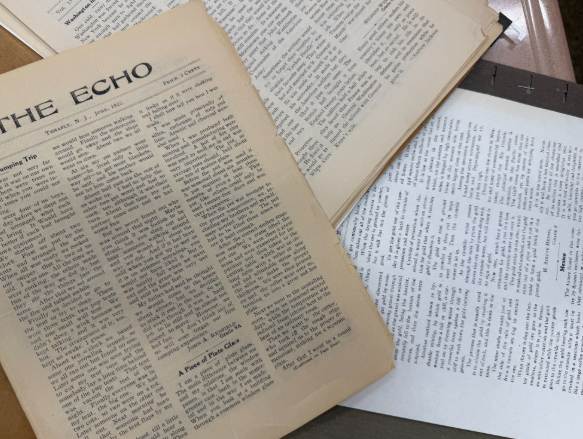
For 130 years, The Echo has done something deceptively simple: it has paid attention.
It has paid attention to the way students think, argue, celebrate, protest, question, and create. It has recorded hallway rumors and school traditions, everything from school musical productions to schoolwide lipdubs, moments that seemed monumental and moments that barely registered at the time. In doing so, it has done more than build an archive of events, translating it into an archive of perspective—a living, breathing record of how generations of students walked the halls of THS.
Ladies and gentlemen, we present to you: 130 years of The Tenafly Echo.
Founded in 1896, The Echo stands as one of New Jersey’s oldest high school newspapers. The Echo’s history is not merely archived in fading print editions or attributed hyperlinks; it lives most vividly in the memories of those who once hovered over drafts at midnight, negotiating deadlines and stories.
Michelle Lee (’21), former Co-Editor-in-Chief, remembers the peculiar alchemy of responsibility and adolescence colliding. During COVID, at just sixteen years old, she found herself calling the Tenafly police to report on a burglary story—an act that felt at once nerve-racking and electrifying.
“It’s encouraging and vital for teenagers to feel their opinions are valued outside of a purely academic context,” she said. “The Echo is an invaluable platform for students to reach the broader THS community. Not everyone goes on and becomes a professional journalist after The Echo. However, the skills of meeting deadlines, clearly articulating a story, and reaching an audience stay with you beyond high school and college. Your perspectives may change over time, but you’ll never forget the stories you choose to tell as a young person […] I say this fully knowing I wrote a story on Among Us during the pandemic, haha.” (The Among Us article in question.)
For Seren Park (’21), who also served as Co-Editor-in-Chief during the pandemic, The Echo became an unlikely anchor amid disorientation.
“We couldn’t meet in person for pitch meetings, there were fewer school events to cover, and I never even met some of the staff writers face-to-face,” she recalled.
And yet, the paper endured. That perseverance would ripple outward. Park now studies journalism at Northwestern University, still tracing her editorial instincts back to those remote meetings and hastily filed stories.
The Echo was not only memorable for past writers and students at Tenafly because of the thrill of writing and covering stories, but was also cherished because of the memories made in between pages: Norhan Zouak (’21) recalled crossword puzzles in journalism class, and Bina Lee (’21) remembered a digression about Chemex coffee during Journalism with such enthusiasm that it permanently altered her café orders.
“The Echo is such a wonderful opportunity to learn your creative outlet (even if you don’t consider yourself to be so)—whether you discover a niche topic you enjoy writing about, want to try writing a Humor story, take on a short film project, etc.,” Zouak said.
“Continue to join or support student journalism well after high school,” Lee said. “My time at The Echo only helped me when I continued being a reporter for my college’s newspaper. You probably already feel this now, but student journalism is so integral for giving students a voice and also keeping them in the know with what is going on in their school and connecting them to their nearby community.”
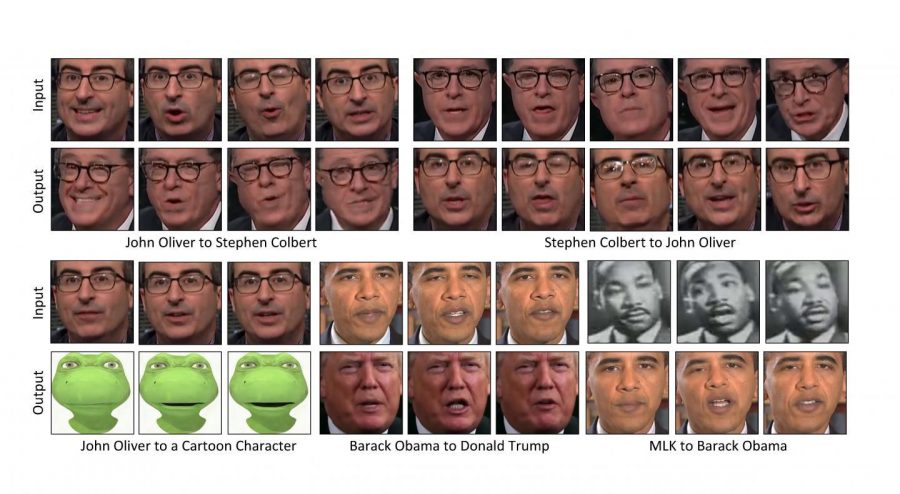
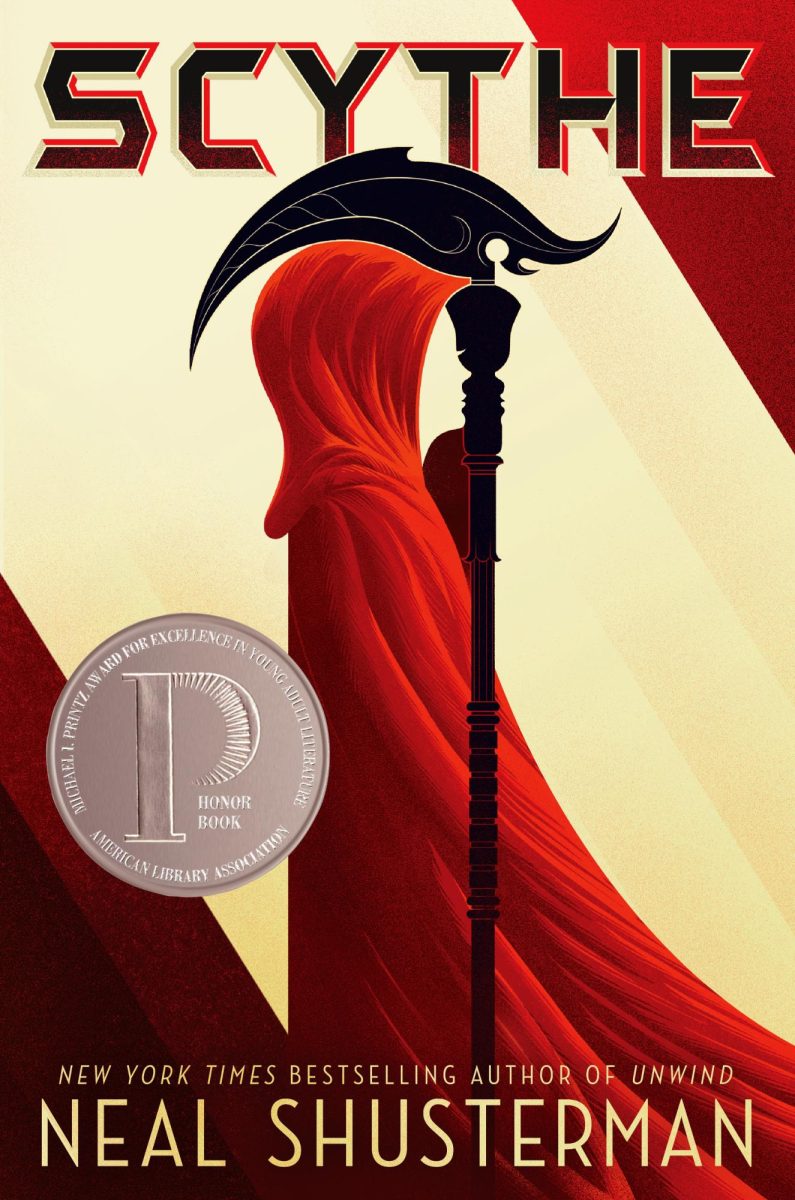
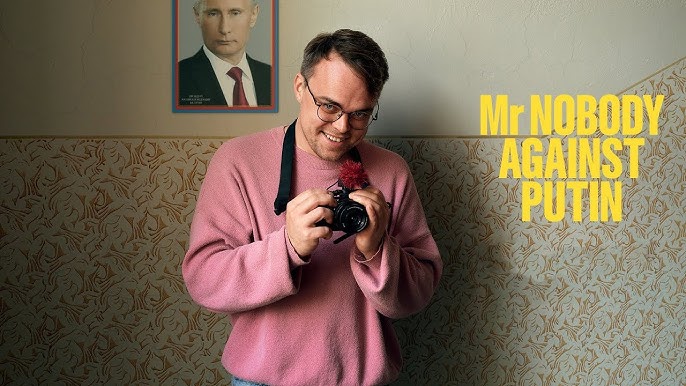
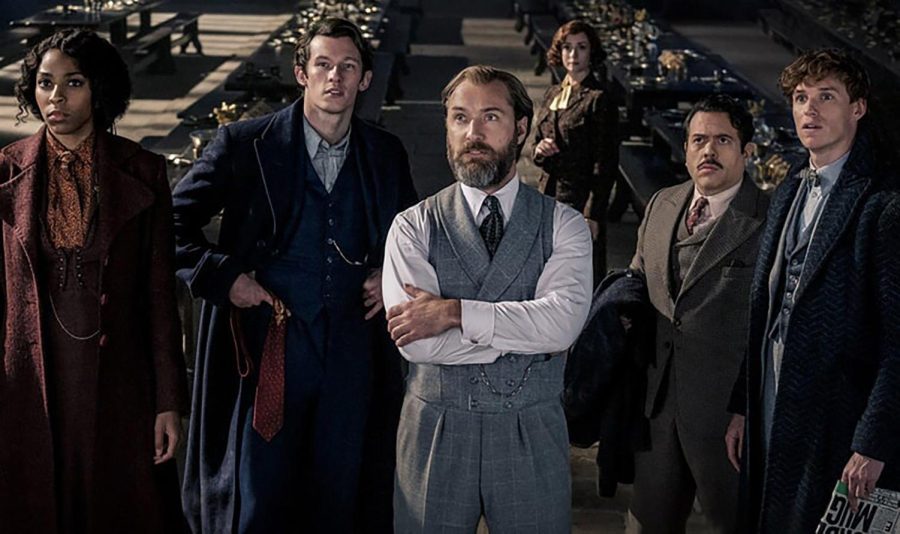
For Gavin Clingham (’23), The Echo became an unexpected proving ground. What began as a curiosity—writing increasingly sharp, almost gleefully ruthless reviews of notoriously bad films—evolved into something more foundational. His now-infamous critique of Cats was not simply an exercise in satire; it was the moment he realized that voice could be sharpened through risk (the scathing review in question). That willingness to push tone and opinion to their limits eventually became part of his application to the University of Texas at Austin’s film program, where he studies today.
“Always try new stuff,” Clingham said. “When I was writing, I would [delve] into very weird movie reviews, questionable humor pieces, and push the boundaries with political pieces, but it challenged me in a fundamental way. The more you push your own boundaries, the more you evolve yourself or the newspaper you’re writing for. [Because] even if you think your writing is too weird for the newspaper, there just may be a place for it.”
For Ryan Kim (’23), it was simpler: write what you love.
“[A] piece of advice is something that sounds really obvious, but make sure that you are writing something you are passionate about,” Kim said. “Passion is palpable, especially through writing. It also makes it feel less like work and makes the process so much easier. Looking at previous articles with fresh ideas is a great idea, and will help you in higher education when you understand your writing style more thoroughly.”
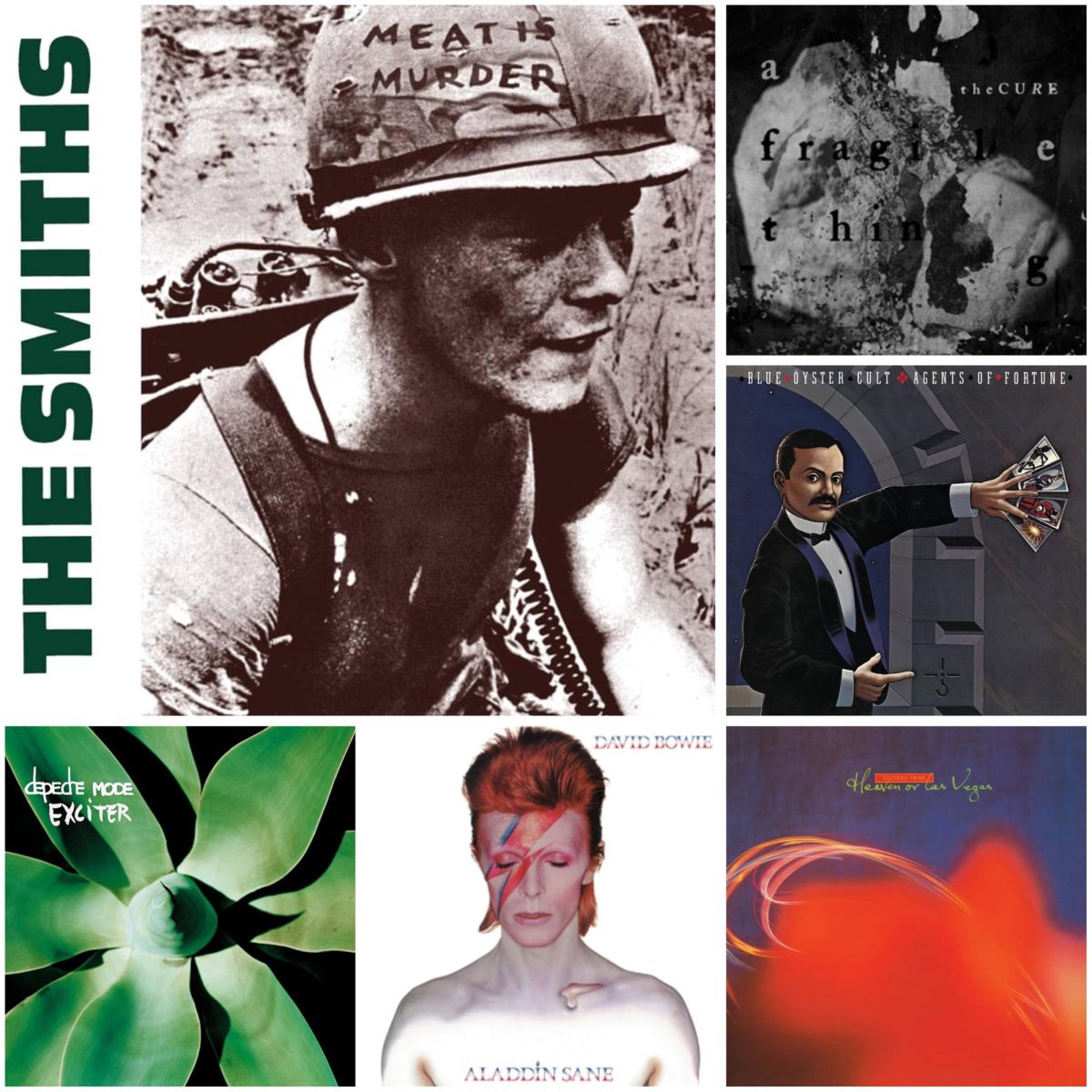
Writing about music—albums he cared about deeply—allowed Kim to refine his arguments without the sterile pressure of a graded essay prompt.
“My love for music, which can be clearly seen in the archive of The Echo, has carried on to college, as I do college acapella and am now performing in a student-made musical in the spring,” Kim said. “I used to have very bad imposter syndrome and was always anxious when having to show my abilities and talents, and The Echo helped me become a stronger writer and helped my arguments and claims [become] more cohesive, which has helped with various final papers. I will carry the impacts of The Echo for the rest of my life, and am grateful for the beauty of it that Mr. Whitehead has sustained.”
Gia Shin (’23), former Editor-in-Chief and now writer for Brown University’s college newspaper as a student, remembers something subtler—the moment when her work left the screen and entered conversation: “The responses I would get from other students, staff, and teachers who read my articles were very gratifying. It’s sometimes hard to know what kind of impact your stories have, so hearing other people talk about what they thought of my articles was very memorable.”
Shin also emphasized that journalism is an effective way to stay informed and connected to local communities.
“The skills you learn by doing journalism in high school transfer over to so many other aspects of your life—asking the right questions, thinking critically about deeper implications, and not taking things at [face value] are skills that are more important now than ever before,” Shin said. “I’m glad I took the chance to join The Echo during my freshman year of high school—it truly gave me the proper training I needed and opened my eyes to a potential future career in journalism. In college, I’ve finally found my niche in business journalism—talking to local business owners and breaking down complex topics in finance makes me feel very informed about my community and the overall markets.
Similarly, Liam Tenenbaum (’25) described his trajectory from tentative staff writer to Editor-in-Chief as transformative.
“The excellence expected out of The Echo is nothing but a testament to how great a club it is,” he said. “Teachers, parents, and students are excited to see the fresh stories hit their inbox every Friday. I was extremely proud to be a small part of that. I think my time as editor really shaped my ability to lead others and demand excellence out of myself today.”
Tenenbaum credits the paper with preparing him for the rigors of collegiate seminars. The discipline of deadlines and the humility of revision traveled with him to college.
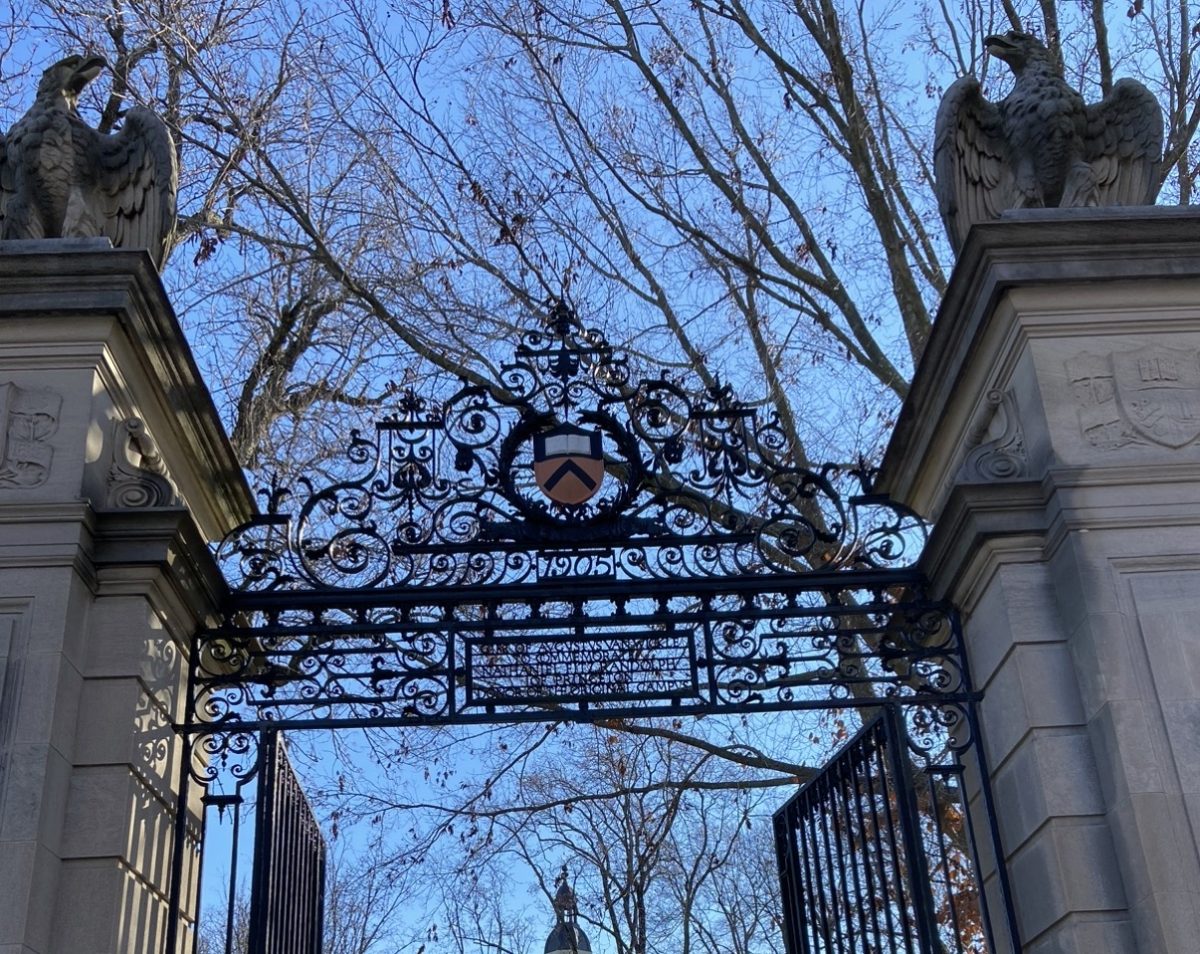
“At Princeton, we have a required first-year writing seminar that is typically considered to be quite difficult,” he said. “However, I do think that my time with The Echo was extremely conducive to the abilities I now use for my papers.”
Pablo Estua Carrillo (’25) remembers his acceptance as Sports Editor as a culmination of “numerous late nights spent researching and writing pieces.” But editorship, he emphasized, is not merely about revising others’ work; it is also about the development and success of younger, aspiring writers.
“Being able to influence and lead The Echo, as well as cultivate a closer bond with its wonderful advisor, Mr. Whitehead, is one of my favorite experiences from high school in general and one that I will certainly never forget,” Estua Carrillo said.
For 130 years, these stories—of risk, growth, sharp edits, and sharper opinions—have accumulated into the publication Tenafly sees now. And while alumni carry The Echo’s lessons into college newsrooms, film programs, lecture halls, and beyond, the paper itself continues to evolve within the walls of THS.
Head over to “Tenafly’s Student Newspaper over the Years (Part II): 2026 Ver.” to read on—because what’s a newspaper without a sequel?