
































































































































Welcome to the Triple C’s—proof that reading for school can turn into reading for fun (and vice versa). Whether inspired by social media hype, a Barnes & Noble display, a Goodreads email, a syllabus, or pure curiosity, this weekly review is where my honest thoughts end up. Suggestions are always welcome, and the next review is already underway.
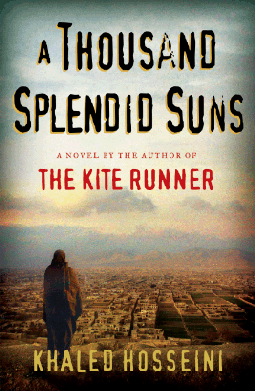
Looking back on freshman year, there wasn’t a book I disliked more than The Kite Runner. While the plot was undeniably captivating, I found it unnecessarily long and exhausting. After studying the Near East in history class, I was disappointed that a novel centered on the region failed to hold my interest. Nearly two years later, I decided to give Khaled Hosseini another chance.
A Thousand Splendid Suns tells the story of two Afghan women whose lives intersect amid decades of political upheaval. Mariam, an illegitimate child from Herat, is raised to survive through domestic roles, while Laila, growing up in progressive Kabul, sees education as essential. Despite their differences, marriage to the same man forces them together, and resentment slowly transforms into a deep, unbreakable bond. Their relationship becomes the heart of the novel, showing how solidarity and compassion can emerge even in harsh circumstances.
The novel’s strongest element is its characterization. Mariam’s quiet endurance contrasts with Laila’s determination, offering two distinct responses to constant hardship. Their stories unfold alongside Afghanistan’s turbulent history, from the Soviet invasion to the rise of the Taliban, but Hosseini never overwhelms the reader with politics—he grounds history in everyday life, illustrating how women’s freedoms steadily disappear.
Several moments have lingered with me long after closing the book. One pivotal scene is the death of Laila’s parents, particularly her father. Immigration is a recurring theme in Hosseini’s novels. During the Taliban’s oppressive rise, Laila’s parents decide it is finally time to leave Afghanistan. While preparing their last possessions, her father is killed by a rocket. Laila visualizes the scene: “Babi’s headless torso landing nearby, the bridge tower printed on his T-shirt poking through thick fog and blood” (Hosseini 230). This moment is devastating, symbolizing the loss of hope and the shattering of Laila’s family.
Overall, A Thousand Splendid Suns left a lasting impression on me—far more than The Kite Runner ever did. It is a moving and thoughtful novel that balances intimate storytelling with broader social reflection. While emotionally demanding, it is well worth the read and serves as a reminder of the importance of empathy, especially toward voices that are too often unheard, and to personally appreciate the privileges that can so easily be taken for granted.